Artist Birthday: Morton Schamberg (1881-1918 US)
The abstractions of Morton Schamberg have numerous sources among the modernist movements of the first two decades of the 1900s. Among the strongest influences were Cubism and Futurism.
Artist Birthday for 15 October: Morton Schamberg (1881-1918 US)
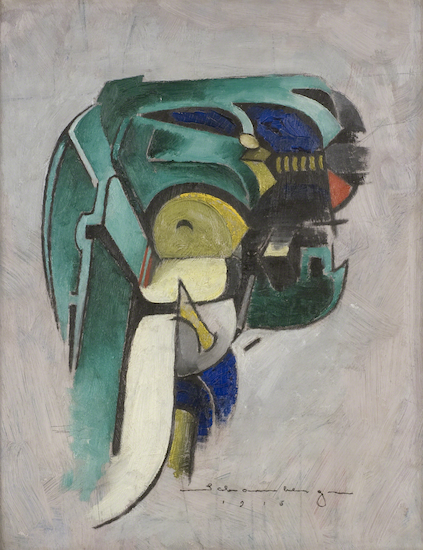 |
| Morton Schamberg, Painting IV (Mechanical Abstraction), 1916, oil on wood panel, 44.1 x 36.5 x 3.5 cm Philadelphia Museum of Art, © 2026 Artist or Estate of Artist (PMA-8960) |
One development from Cubism was art that celebrated the ever-expanding machine world. The geometric basis of Cubism provided many analogies to machine forms. This painting is one of a series of nine paintings of individual, made-up machines that Morton Schamberg made in Philadelphia in 1916. He drew inspiration from technical trade manuals, although there was a precedent in works by Surrealist artists Marcel Duchamp (1887-1968) and Francis Picabia (1879-1953) who created precisely detailed images of imaginary machines, such as Duchamp's Chocolate Grinder of 1914.
These paintings are pristine and spare pictures, revealing the artist's appreciation of the formal beauty of machinery and industrial manufacturing. They can be viewed today as an important precursor of the Precisionist aesthetic developed by Schamberg's lifelong friend Charles Sheeler (1883-1965), who is renowned for his sharply delineated, realistic paintings of industrial machinery.
Background
At the beginning of the 1900s, American sculpture was still dominated by the classical aesthetic that had endured through the 1800s. The style was firmly entrenched in the conservative art institutions like the National Academy and American Sculpture Society in New York, and the Pennsylvania Academy of Fine Arts in Philadelphia.
After the Armory Show of 1913, which was Americans' first exposure to European modernism, the uniform acceptance of the academic classicism in sculpture was shattered. American sculptors in droves began exploring a great diversity of styles that were more progressive -- an expressive style influenced by the sculpture of Rodin, a realist counterpart to the Ash Can School, Art Deco, and experimentation with form inspired by the European modernist styles from the Armory Show including Cubism, Expressionism, Futurism, Dada, and Surrealism.
Morton Schamberg trained as both an architect and painter, and was one of America's foremost modernist artists before World War I (1914-1918). He was a visionary who saw beauty in the shapes and lines of machines. He was also an accomplished portrait photographer.
Born in Philadelphia, Schamberg studied at the University of Pennsylvania and then the conservative Pennsylvania Academy of Fine Arts. In 1910 he went to Paris where he discovered modernist art, being especially influenced by Paul Cézanne (1839-1906), Pablo Picasso (1881-1973) and Fauvist Henri Matisse (1869-1954).
Cubism and Fauvism steered him away from his academic experience towards abstraction. Returning to Philadelphia, in 1915 he was producing canvases with the bold colors of Fauvism, and the planar displacement of Cubism. He exhibited his Cubist/Fauve-inspired works at the Armory Show. Unfortunately, he died, full of promise, in the influenza outbreak of 1918.

Comments