Artist Birthday: Marguerite Kumm (1900-1992, US)
Marguerite Kumm was an artist involved in the transition of printmaking into a highly respected art form during the Great Depression (1929-1940). Her work is typical of the inward-looking artwork that the Depression spawned in the US.
Artist Birthday for 9 October: Marguerite Kumm (1900-1992, US)
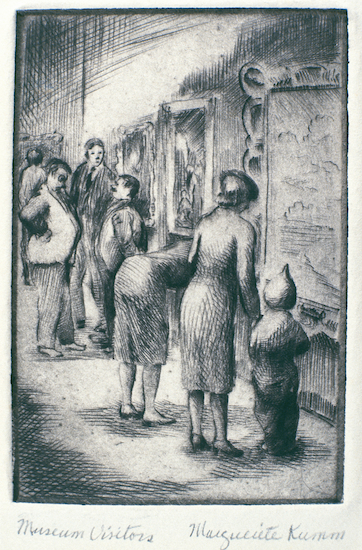 |
| Marguerite Kumm, Museum Visitors, ca. 1940, drypoint on paper, 8 x 5 cm Butler Institute of American Art, Youngstown, OH, © 2026 Artist or Estate of Artist (BIAA-375)
|
Marguerite Kumm was born in California. She studied art in Minneapolis and Washington DC. Working for the WPA, she painted murals and produced hundreds of etchings. Like Mabel Dwight, they featured everyday life of the American public.
Background
There was a relatively rapid march towards modernism in American art that occurred in the first two decades of the 1900s, particularly after the 1913 Armory Show in New York, which introduced Americans to the latest European modernism. This interest in modernism evaporated almost completely after World War I (1914-1918), when Americans were no longer interested in anything that reminded them of Europe. The advent of the Great Depression (1929-1940), a severe, world-wide economic downtown, sealed the fate of development of American modernism until after World War II (1939-1945).
During the Depression, the New Deal economic program meant to relieve unemployment included the Works Progress Administration (WPA) Fine Arts Program (FPA), founded in 1935. Men and women of all ethnic backgrounds, who could prove they had worked previously as an artist, were eligible. Almost 1200 printmakers enrolled in the program, producing an estimated 11,300 different images.
Interestingly, the FPA artists produced both abstract and realistic images, although Social Realism was the dominant trend in painting. The program's system of setting up studios and fostering education and innovation was hugely responsible for the emergence of printmaking as a major fine art form in itself after the war.
Correlation to Davis programs: Experience Printmaking, Chapter 5 Intaglio; Davis Collections – The American Scene Between World Wars 1918-1940

Comments