Artist Birthday: Lovis Corinth (1858-1925 Germany)
Lovis Corinth was an important transitional painter between the Romanticism and Symbolism movements of the late 1800s, and Expressionism of the early 1900s.
Artist Birthday for 21 July: Lovis Corinth (1858-1925 Germany)
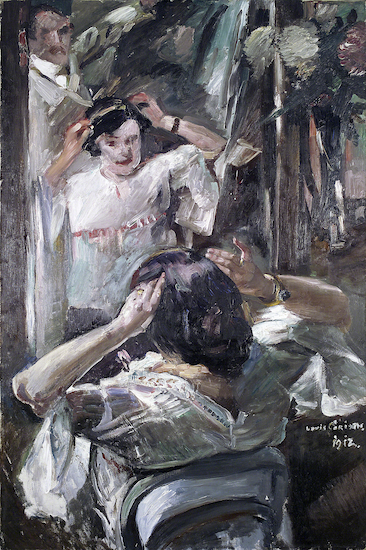 |
| Lovis Corinth, At the Mirror, 1912, oil on canvas, 139.7 x 91.4 cm © 2026 Worcester Art Museum (WAM-593) |
After settling in Berlin in 1901, Corinth’s mature work evolved, frequently involving dramatic treatments of religious, mythological or historical subjects. They were rendered with loose brush work and strong colors that is often linked with Expressionism, although Corinth himself rejected that movement when it first appeared. However, he later came to embrace Expressionism’s intensely emotional approach in his own work.
Many art historians consider Corinth’s work after his stroke of 1911 to be his finest. In works like this, the broken color, importance given to lighting, and gestural brush work reveal something of Impressionism’s influence, while pointing the way towards Expressionism. Handicapped and traumatized by his illness, Corinth turned from the Impressionist style that had defined his career and embraced a looser, Expressionist treatment of his subjects.
One of the first paintings to be completed following his stroke, At the Mirror exemplifies Corinth’s new mode of painting. His wife, the talented artist Charlotte Berend (1880-1967) sits at her dressing table, while the artist watches over her shoulder. The angle of their reflection in the mirror suggests that we take on the artist’s perspective. While Corinth had earlier used portraits as a means for self-revelation, here he presents both himself and his wife in a more generalized manner, distancing the figures. Given Corinth’s state of anxiety and depression during this period, the inscrutability of the artist’s gaze as he melds into the background perhaps indicates his psychological state.
Background
The term “expressionism” in the early 1900s typically refers to art that contains emotional content, usually conveyed by personal technique, such as overt gesture, jarring color, and active line. Such qualities can also pertain to certain artists of Romanticism of the first half of the 1800s. The beginnings of Expressionism in Germany can be found in the intensely personal aesthetic explorations of German Romanticism.
German Romantic artists expressed feelings of loss and longing. Even German Renaissance painters were fans of emotionalism in their intense religious paintings. Expressionists also drew from art of other cultures and folk art traditions. One of the artists the helped in the transition from Romanticism to Expressionism was Lovis Corinth.
Corinth was born in Tapiau, East Prussia, no Gvordeysk, Russia. He underwent academic artistic training at the Königsberg Academy in 1876, and academically in Munich from 1880 to 1884, where he was schooled a romantic/classicist realism. During a visit to Antwerp (Belgium), he was impressed by the gestural quality of Flemish Baroque painters such as Peter Paul Rubens (1577-1640) and Antonie van Dyck (1599-1641).
In 1884 Corinth moved to Paris to complete his studies at the Academy Julian, where he studied under an academic classicist/realist. Surrounded by the full-bloom Impressionist movement at the time, Corinth could not but help be influenced by its gestural surface and impactful light. In 1887 he returned to Germany where he soon became involved in the Secession, an artists’ movement that demonstrate against the conservative curriculum and dictatorial juries of academic art schools in Berlin and Munich. In 1911 he suffered a stroke which left him partially paralyzed, but his subsequent work displayed an even more vigorous brush work than before.

Comments