Artist Birthday: Julio Le Parc (1928-2026 France, born Argentina)
When the subject of Op Art (optical art) comes up, usually artist names such as Victor Vasarely or Bridget Riley usually spring to mind. Julio Le Parc was a pioneer of motion and light artworks starting in the late 1950s that led the way towards Op Art in the 1960s.
Artist Birthday for 23 September: Julio Le Parc (1928-2026 France, born Argentina)
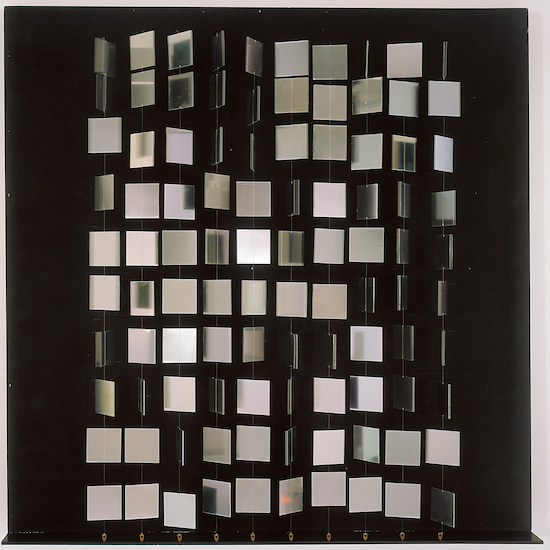 |
| Julio Le Parc, Unstable—Continual Light, ca. 1962, metal, wire, and wood, 80 x 80 cm Buffalo AKG Art Museum, Buffalo, NY, © Julio Le Parc / Artists Rights Society (ARS), New York (AK-492lpars) |
In the early 1960s, Le Parc began working in three dimensions, incorporating moving, projected and reflected lights. From 1964 on he began producing works based on distorting mirrors and the displacement of the spectator by means of labyrinths and play rooms. He was truly the bridge between the kinetic sculpture/installation wing of Op Art and the painting wing. In the words of the manifesto of his group in Paris Group for Visual Arts Research, artists such as he believed it was “forbidden not to participate” in a work of art, “forbidden not to touch” a work of art, and “forbidden not to break” a work of art in order to experience it completely.
Unstable-continual Light is composed of highly polished metal paillettes hung on nylon thread in front of a black backdrop. The slightest air disturbance causes a significant degree of interplay among these elements, which also reflect their surroundings to create a brilliantly random play of light and shadow, and also help include the viewer as a participant whose image is reflected in the shiny paillettes.
Background
In Argentina, between the time personal freedoms were increasing in the late 1910s, into the 1940s, most modernist art was influenced by European artists such as Expressionists, Surrealists, and Fantasy artists like Paul Klee (1879-1940).
After World War II (1939-1945), a growing number of Argentinian artists studied not only in Paris, but also in New York, where Abstract Expressionism was just taking off. The 1946 White Manifesto written by a number of Argentinian artists argued for the supremacy of non-objective abstraction. From that period on, Argentinian modernists participated in every avant-garde movement in Western art.
Julio le Parc was born in Mendoza, Argentina, studied sculpture in Buenos Aires where he became interested in avant-garde movements influenced by what was happening in Europe and America. In 1958 he went to Paris. During the late 1950s, numerous exhibitions of light and motion art took place in Europe, and became the focus of many artists' organizations and manifestos. Le Parc's early sculptures were experiments in layering clear sheets of Plexiglas to create visual movement. He was one of the first sculptors to create moving sculptors and multiple-piece works in which the public was invited to interact with.
Le Parc became one of the founding members of the Group for Visual Arts Research. He also produced geometric abstract painting based on predetermined systems in reaction to the French group Art Informel/Tachisme. This movement was influenced by the optical paintings of Victor Vasarely (1908-1997), the theories of Piet Mondrian (1872-1944), and the Russian Constructivists. His early optical geometric paintings done in black, white and grey gradually became as many as 14 colors.
Correlations to Davis programs: Exploring Visual Design 5E, lesson 12.1; Davis Collections -- Latinx Artists, Central and South America

Comments