
Artist Birthday: Jacques Soufflot (1713-1780 France)
Jacques Soufflot was at the forefront of the Neoclassicism that swept European art and architecture at the end of the 1700s. Even though he died before the Revolution (1789), his Church of Sainte-Geneviève, with its classical severity and purity of form, fit perfectly into the Enlightenment ideals that spawned the Revolution.
|
Artist Birthday for 22 July: Jacques Soufflot (1713-1780 France)
|
|
| Jacques Soufflot, Panthéon, Paris, 1757-1790 Image © 2026 Davis Art Images (8s-29801) |
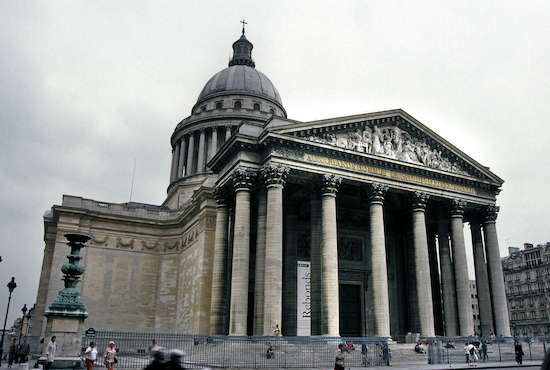
The Panthéon was originally intended as a church dedicated to Sainte-Geneviève. At the height of the Revolution, in 1791, the revolutionary council decided to rededicate the just-completed church as a mausoleum for France’s greatest heroes.
Soufflot's designs from the very beginning were severe in their reduced decoration, but spacious in the Baroque sense. He meant for Saint-Geneviève (the Panthéon) to be the largest church in Paris. The exterior shows his spare use of decoration in the swag reliefs at the roof line, Corinthian column capitals, and pediment frieze. The design was influenced by Wren's dome of Saint Paul's Cathedral, a Baroque structure in London, and the pedimented entrance was influenced by the Pantheon in Rome.
Background
The in-depth exploration of the ruins of the ancient Roman resort town of Pompeii in Italy in 1748 helped push an already burgeoning movement that eschewed the materialism of the Baroque period in favor of a return to classical (ancient Greece and Rome) learning that had been espoused in the Renaissance. This renewal of interest in classical culture coincided with great strides made in science, engendering a movement called the Enlightenment. This movement also spread to the arts, where once again ancient Greek and Roman art were imitated.
The style was called Neoclassicism. The style coincided with, and expanded because of the political climate of the late 1700s which witnessed the democratic revolutions in France and the US.
Jacques Soufflot was an early representative of the nascent Neoclassical movement in architecture in France. He was born in Irancy and studied architecture at the Royal Academy in Paris. He also studied the classicism of Renaissance architecture in Italy, such as the works of Mannerist Renaissance architect Andrea Palladio (1508-1580) and heavy classicism of Saint Peter's in Rome.
Although Soufflot was aware of Rococo architecture, he rejected its irregular lines and over-ornamentation in favor of a classicism which would give architecture the gravitas he felt it was lacking. When he returned to France from Italy he opened an architect's office in Lyon.

Comments