Artist Birthday: Giorgio de Chirico (1888-1978 Italy)
Pioneer Surrealist Giorgio de Chirico once stated that one must look at all elements of the real world as an enigma. He made paintings of classical piazzas populated with spectral figures and shadows, knitting together purposefully distorted perspectives and tilted grounds. These crowded dreamscapes, contain an atmosphere of melancholy and mystery of objects that evoked hidden symbolism. His work later inspired the Surrealists.
Artist Birthday for 10 July: Giorgio de Chirico (1888-1978 Italy)
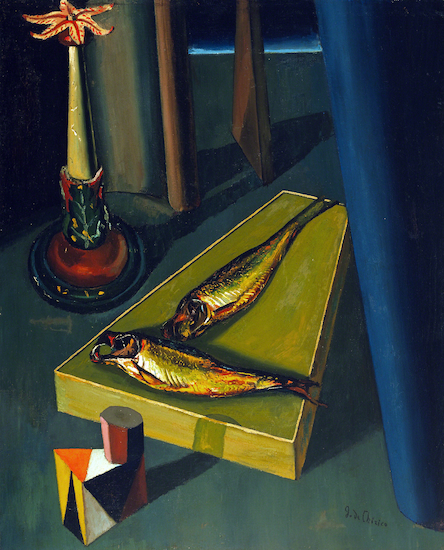 |
| Giorgio de Chirico, The Sacred Fish, 1919, oil on canvas, 74.9 x 61.9 cm The Museum of Modern Art, New York, © 2026 Artists Rights Society (ARS), New York (MOMA-P3186chars) |
The period between 1911 and 1914 are represented in de Chirico's work by his most recognizable subject matter, the large open plaza with pseudo-classical architecture. These works inspired a sense of uncertainty and fear about what kind of reality these scenes portrayed, a basic kind of metaphysical concern. They contained recognizable forms that seemed to go logically together, particularly in proportion to one another.
After 1915 when de Chirico returned to Italy, he concentrated on more intimate explorations of his idea of "metaphysical" -- anything that appeared strange, unsettling, or unnatural (to the people of that period). De Chirico's paintings of from 1915 to 1920 are often close-ups of skewed interiors where spatial relationships are unnatural, planes are tilted, and an assortment of unrelated objects dominate the space. The incongruity of objects occupying the same space is part of Nietzsche's theories on the metaphysical that question just what reality is.
Background
After the reunification of Italy in 1848, Romanticism and Classicism maintained a strong hold on Italian art into the 1900s. In the country that was nominally the "birthplace" of the Renaissance, academic classicism naturally held sway. Those influenced by movements such as Impressionism, such as Giovanni Boldini (1842-1931) went to France (Boldini ended up staying there after 1872), or Symbolism, went to Germany. Those imported styles remained, for the most part, aspects of the academic style that was favored by patrons.
In the first decade of the 1900s, younger artists, as well as progressive elements of society in general, sought to break the stranglehold of the "illustrious" tradition of Italian culture and reflect the economic and social possibilities of the new century. The Futurists, whose manifesto came out in 1909, were the first group of artists to reflect this yearning for modernism in art that was a combination of Post-Impressionist and Cubist styles.
The Futurists coincided with a group of artists who painted in the "Metaphysical" style, a combination of the omnipresent classicism of Italy, Surrealism, and elements of Cubist space. Although the two movements coincided chronologically, their motivations were different. Futurism emphasized representations of the present, movement and progress, while the Metaphysical painters established timeless, usually static visions.
Born in Greece, de Chirico lived in Italy after 1909. From 1903 to 1905 he studied at the School of Fine Arts in Athens. From 1906 to 1910 he studied at the Academy of Fine Arts in Munich, where Symbolism was a major force in painting. He was particularly influenced by the Symbolists Max Klinger (1857-1920) and Arnold Böcklin (1827-1901, Swiss). Both artists worked in a realist style with disturbing, often sexual imagery, in subjects where elements were often oddly juxtaposed or did not seem related to one another, but were part of a personal narrative.
Returning to Italy in 1910, he was engrossed by the philosophy of Friedrich Nietzsche (1844-1900), who question religious, moral and social conventions in the proposal that the physical reality people believed in was not the most important one. His description of empty squares in Turin surrounded by arcaded buildings greatly affected de Chirico.

Comments