Artist Birthday: Gabor Peterdi (1915-2001 US, born Hungary)
Besides being conversant in a number of modernism movements in the first half of the 1900s, Gabor Peterdi was very influential in exploring printmaking processes in modernist takes on landscape.
Artist Birthday for 17 September: Gabor Peterdi (1915-2001 US, born Hungary)
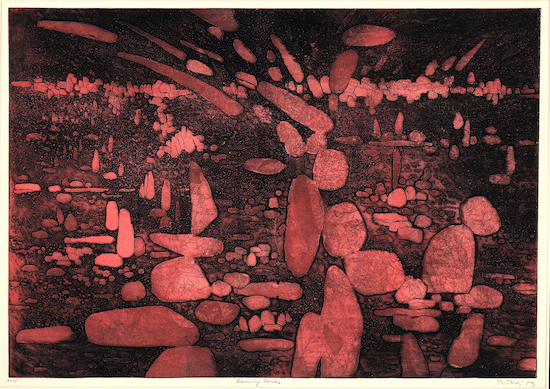 |
| Gabor Peterdi, Burning Rocks, 1959, color etching on paper, 63.5 x 87 cm, Buffalo AKG Art Museum, Buffalo, NY, © 2026 Artist or Estate of Artist (AK-597) |
By 1950, Peterdi had returned to one of his favorite subjects which was landscapes. It was invigorated by his move from New York to rural Connecticut. Peterdi explored various graphic media, but he is best known for his color etchings and engravings. Peterdi's art is neither purely naturalistic nor abstract; instead, his use of line, shape, and tone is forceful and expressive, evoking the essence of his subjects, somewhere between reality and a dream world. His work often conveys the power of nature, such as Burning Rocks.
The rock formations, lava flows, and ice fields that he had seen during travels throughout the United States inspired the content of his prints. Rocks were a frequent subject (take for example The Big Rock, 1961), where he heightens their visual power beyond mere elements of nature through color and vital linearity, endowing them with an energy that likens them to living organisms. Unlike etchings with more than one color, Peterdi used only one plate for Burning Rocks, printing the un-scraped plate to print the red, and then printing the black scraped design into the overall color.
Background
There was no great graphic arts movement among the "old school" masters of modernism from before the war in European art in the late 1940s. Many of the masters -- such as Chagall and Miro -- viewed printmaking as a way of extending their painting. After World War II (1939-1945), British artist William Stanley Hayter's (1901-1988) Atelier 17 (founded 1927) printmaking studio moved from Paris to New York.
Atelier 17 became an important influence on the development of printmaking among the new generation of American modernists (such as the Abstract Expressionists). It also helped increase the interest in printmaking in America. One of the significant differences Atelier 17 had from European printmaking traditions was that Hayter insisted that the artists who worked there cut and print their work themselves. This ended up encouraging them to investigate the wide variety of printmaking techniques.
Gabor Peterdi was an avid student of Atelier 17 before the studio moved to New York. Born in Budapest, Peterdi was painting little landscapes by the age of 5. He won a Prix de Rome at 15 and studied in Rome for a year, then moved to Paris. Between looking at the latest modernism in galleries and old renowned works at the Louvre, he became involved in the avant-garde movement.
Influenced by the Polish printmaker Sigismund Kolos-Vari (1899-1983), Peterdi joined Atelier 17 in 1927 where he worked alongside Chagall, Picasso, Ernst and Giacometti. His goal was to learn about as many printmaking processes as possible.
He emigrated to the US in 1939, and worked as a cartographer for the US army at the end of the war. In 1945 he rejoined Atelier 17 in New York. The late 1940s was a period of feverish experimentation with multiple printmaking process, wherein the artist explored both abstraction and representation, seemingly unaffected by the frenzied popularity of Abstract Expressionism.

Comments