
Artist Birthday: F. Holland Day (1864-1933 US)
Pictorialism was a late 1800s-early 1900s style of photography which consciously imitated effects of painting. Who better to take a portrait of a Pictorialist artist than another, the “king” of Pictorialism, F. Holland Day?
Artist Birthday for 23 July: F. Holland Day (1864-1933 US)
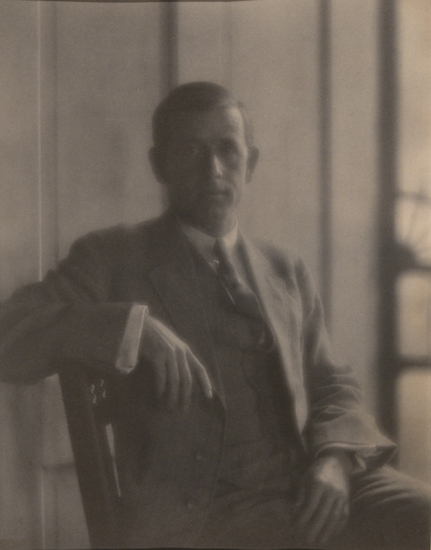 |
| F. Holland Day, Portrait of Clarence White, platinum print on paper, 24 x 19.4 cm Image © 2026 Philadelphia Museum of Art (PMA-4952)
|
Day had unerring judgment in his asymmetrically balanced compositions and timing on lighting and mood in his photographs. The same romantic mood with which he imbued his models, came across in his portraits. This portrait is a fitting tribute to Day's friend and colleague Clarence White (1871-1925), an artist whose work exemplified the Pictorialist movement. Day daringly limited to lighting to only that coming through the window, creating a dominant contrast of dark and light on White's figure, although White's right hand receives illumination, a symbol of his handiwork as a photographer. The soft focus is a given for all Pictorialist photography. Like most Pictorialists, Day preferred the platinum print process because the negative could be easily manipulated to further blur the image.
Background
In the first seventy years after the development of photography, the art form was not widely recognized by established art academies as a "fine art" in the manner of painting and sculpture. Many early photographers modeled their subject matter and compositions on painting in order to be considered artists in their own right. This style, which often took up mythological, religious or historical subject matter was known as "art photography" or Pictorialism.
Art photography did not become popular in the United States until the 1890s. By that time, Impressionism from Europe had an impact on painting in the United States, though not in painting sponsored by the academies in New York and Philadelphia. The impact the impressionist movement had on art photography is seen in works that imitate the atmospheric and soft-edged aspects of a painting.
Photographers who worked in the Pictorialist style believed that their photographs came the closest to the aesthetic ideals of painting. These aims were achieved through the choice of romantic, sentimental or allegorical subject matter, careful staging, careful and often dramatic lighting, and generally soft focus.
Frederick Holland Day, born in South Dedham, Mass., was most likely the earliest American practitioner and vocal supporter of Pictorialism. Born of a wealthy family, Day dabbled in book publishing that leaned heavily towards the Pre-Raphaelite and Arts and Crafts Movement aesthetics. He began to practice photography in the mid-1880s, joining the Boston Camera Club in 1889. From his earliest photographs, Day was a committed Pictorialist. His first exhibition was in London in 1895 when he was one of only three American photographers to be elected to the prestigious Linked Ring Brotherhood, a group of Pictorialist-minded artists.
Day's work prominently featured allegorical or mythological subjects with figures in exotic costumes. His most startling piece was a seven-photograph depiction of The Last Words (1898), the subject of Christ on the cross, in which Day posed himself as Jesus. Day became known for refined sense of light and dark and skillful posing of the subject. His works were mounted and framed in architectural, gilt frames, or with multiple layers of colored paper.
Day worked to make Boston the center of the Pictorialist movement. Alfred Stieglitz (1866-1946) was an admirer of Day's work and featured his photogravures in his Camera Notes journal in October 1879 and July of 1898. Day was most active in photography in the years leading up to 1901. He was a prodigious speaker on the topic of Pictorialism, and wrote several articles for Stieglitz's Camera Notes.

Comments