
Artist Birthday: Eugenie Baizerman (1899-1949 US, born Poland)
Eugenie Baizerman was one of a group of pioneer modernist women artists who received recognition “better late than never” in 1949, before the “star” artists of Abstract Expressionism (all men) were featured in the landmark MOMA exhibition “Abstract American Painting and Sculpture (1951).
Artist Birthday for 14 October: Eugenie Baizerman (1899-1949 US, born Poland)
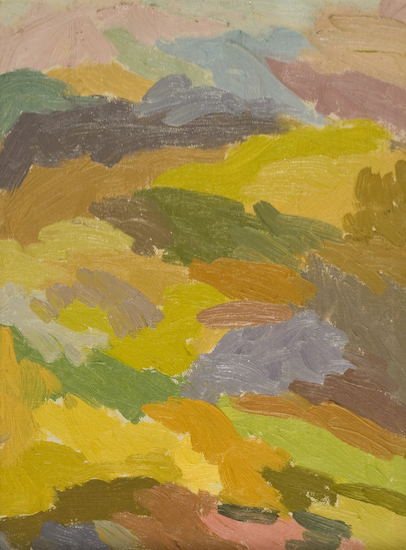 |
| Eugenie Baizerman, Desert Hills (Tuscon Etude #17), 1949, oil on canvas board, 30.5 x 22.9 cm Hirshhorn Museum and Sculpture Garden, Smithsonian Institution, Washington, DC, © 2026 Artist or Estate of Artist (SI-94)
|
Toward the end of her life, Baizerman created landscape paintings of the deserts and mountains of Arizona. In her canvases, the riotous colors create a constant tension between surface and depth. She used the subjects of her paintings - ordinary landscapes, and figures - as the basis for rhythmically combining thick, colorful brushstrokes in abstracted, harmonious compositions. Baizerman and her husband moved to Arizona in 1948 in the hope that the drier weather would help with her severe asthma.
Background
American exploration of modernist art styles basically evolved between the Armory Show of 1913 and the Great Depression (1929-1940). During the Depression, the taste for non-American-inspired modernism was rejected in favor of a "patriotic" "uplifting" social realism that focused on everyday aspects of American life. The influx of European avant-garde artists fleeing the Nazis in World War II (1939-1945) created the first indigenous American modernist art movement, and it was dedicated to abstraction: Abstract Expressionism.
After the advent of Abstract Expressionism in the late 1940s, New York became the center of modernist abstraction, usurping the place Paris had held. Unfortunately, it was a male dominated movement. Commercial galleries were hesitant to feature avant-garde work, so by 1949, a number of artists formed a series of cooperative art galleries in the East Village that catered to abstraction, and the "second generation" of Abstract Expressionism who weren't lucky enough to land commercial galleries. Among those artists, a third were women.
Eugenie Silverman Baizerman was among the pioneering women of the East Village cooperative gallery scene. Baizerman was among a group of women who had explored abstraction in the US before the advent of Abstract Expressionism. Born in Warsaw, Poland, she grew up in Russia. She was granddaughter to an artistic grandfather, actor mother and language teacher father. She was encouraged in art by her parents who hired her a teacher who acquainted her with Art Nouveau aesthetic. She also studied at Odessa Art School.
In 1913 Baizerman's family emigrated to the US. In New York she studied at the National Academy of Design. Her young work was academic in aesthetic, with subdued color sense. In 1920 she met sculptor Saul Baizerman. Traveling to Paris in 1920, her appreciation for color was awakened when she saw the work of Impressionists and Post Impressionists. She began to paint in a Pointillist style, covering canvases in series of brightly colored dots. By 1927, her mature style had emerged, characterized by series of short, gestural brush strokes of vivid color. Her style is sometimes linked to the term Abstract Impressionism.

Comments