A Weekly Beauty Attack
Beauty Attack Monday 11th of May is also the birthday of major Op Art artist Yaacov Agam (France, born 1928 Palestine [present day Israel]). Agam along with Julio le Parc (born 1928 Argentina) and Jesús Rafael Soto (1923-2005 Venezuela) were among the earliest Op artists to encourage the active involvement of the viewer with their works, encouraging movement around their works.
A Beauty Attack Birthday on Monday 11 May: Yaacov Agam
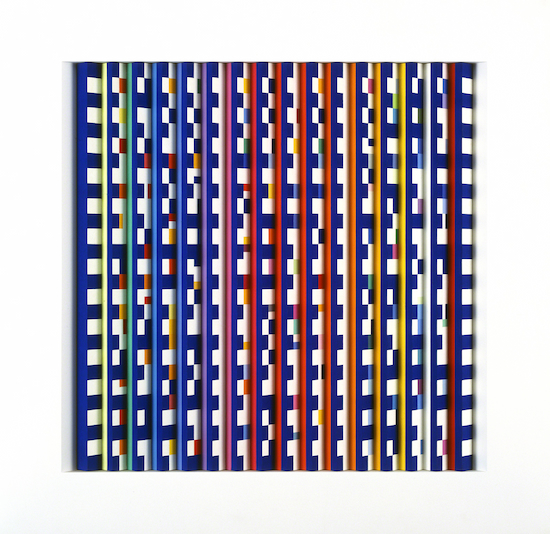 |
| Yaacov Agam, Color and Monochrome – Line and Structure, 1962-1987, synthetic polymer paint on metal with lacquer-finished wood frame, 87 x 89.8 x 4.8 cm (34 1/4" x 35 3/8” x 1 7/8”) The Museum of Modern Art, New York, © Yaacov Agam / Artists Rights Society (ARS), New York (MOMA-P1298agars)
|
Like most of Agam's Agamographs, this work consists of strips painted in varying shapes on two sides of the strips that extend perpendicularly (at a 90 degrees angle from the surface). He has brilliantly contrasted bright warm colors with his "monochrome" of blue that dominates the composition. From certain angles, only the blue shows, while from others the vast array of other bright colors dominate.
Background
Aside from Pop Art, Assemblage and Photorealism in the 1950s and 1960s, there were other experiments in art that bucked the prevailing dominance of painterly abstraction in the 1960s. Color Field Painting evolved into its own during the 1960s, spawning Minimalism, Hard Edge geometric abstraction, and Optical (Op Art). These movements developed by artists who rejected a return to figuration, but wanted to pursue a form of abstraction that ignored the dictates of personal brush gesture, the dominant trend in abstraction after World War II (1939-1945).
Several related tendencies in painting of the 1960s can be put under the designation of Op Art. Op (Optical or Retinal) Art came to the forefront of Western abstraction in the mid-1960s. Stylistically, Op Art is related to color field in the use of areas of pure, unmodulated color, although worked into optically stimulating compositions. The movement came to the forefront of modernism in America in the 1965 Museum of Modern Art exhibition The Responsive Eye.
Although Op Art generated much interest in the US, it evoked far more critical acclaim in Europe, with a light sculptor claiming first prize in the Venice Biennale of 1966. A natural co-development to optical perception of movement was Kinetic Art, in which works of art change the arrangement of elements on parts that either move on their own or by manipulation of the viewer.
Yaacov Agam was born, the son of a Russian rabbi, in Rishon-le-Zion, Palestine (now Israel). He learned drawing as a child, studying art at the Bezalel Academy in Jerusalem (1946-1948) under Israeli abstractionist Mordekhai Ardon (1896-1992). While studying in Zurich (1949-1951), he came under the influence of Bauhaus colorist-abstractionist Johannes Itten (1888-1976), whose painting reflected both Cubism and Russian Constructivism. In Paris (1951) he studied at the Atelier of Abstract Art and the Academy of the Great Thatched Roof, both avant-garde studios.
In Agam’s first solo show in Paris (1953) called Paintings and Movement, he exhibited two types of early work that set the stage for his entire career. In one, grids of painted strips incorporating brightly colored random shapes on both sides of a strip created images that morphed and changed as people shifted viewing position. Those works would be called Agamographs. In the other works, called Transformable Pictures, viewers could manually manipulate works and rearrange the visual elements.
Agam was one of the earliest Op/Kinetic artists who encouraged viewer participation. Throughout his career he continued to produce abstract, kinetic art, many that incorporated light and sound. He also produced many large Op/Kinetic Art installations in public places around the world.
Correlation to Davis programs: Explorations in Art 2E grade 4, lesson 6.7; Explorations in Art grade 5, lessons 3.4, 3.5; Explorations in Art 2E grade 6, lesson 5.1; The Visual Experience 4E lessons 3.4, 7.6; Discovering Art History 4E lesson 17.2

Comments