
A Nice Frock for a hot summer day's garden party in the 1920s
Being an art historian, I have always considered that studying fashion history is a valuable body of knowledge to have because fashion reflects so often throughout history what is going on in the world and art world. Fashion certainly reflects trends that have over the centuries appeared in all art forms. The post-World War I period is particularly fascinating because so many long-standing aspects of getting dressed changed, particularly for women’s clothing. There is a particularly close bond between 1920s fashions and what was going on in art in movements such as Art Nouveau, Art Deco, and Bauhaus.
A Nice Frock for a hot summer day’s garden party
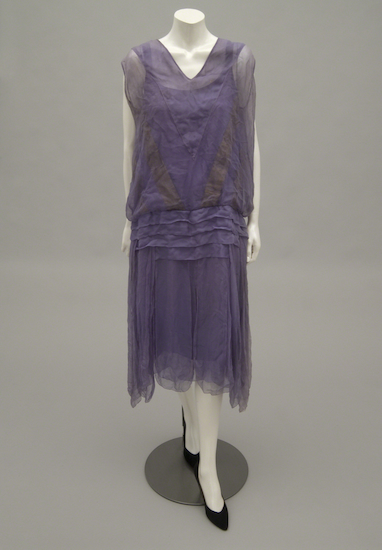 |
| Barbara Lee (brand), Dress, ca. 1925, marketed at Strawbridge & Clothier (1868-1996, Philadelphia), silk georgette, center back length: 101.6 cm (40") © 2026 Philadelphia Museum of Art (PMA-9487)
|
The 1920s, a boom time after the horrors of World War I (1914-1918), is commonly known as the period of the "flapper", the more liberated, carefree modern woman. The fashions of the 1920s were characterized by one fashion editor as being the result of a period of "slap happy optimism," and a lack of poise. However, the idea of the dropped waist, dispensing with restrictive corseting, and shorter skirts had begun immediately following the material shortages caused by World War I.
The revolutionary development of the 1920 was the knee-length skirt, which was initially displayed in fashion shows in 1925. The shorter skirt and dropped waist were meant to highlight a freedom that had not been seen in fashion since the diaphanous women's clothing of the Empire style (ca. 1800 to 1820). The lack of rigid corseting also de-emphasized the woman's bust.
This dress is an example of a "handkerchief frock," which was one of Lee’s fallback forms. It consists of the straight-bodice, straight-skirt androgynous dress with triangular pieces of separate material sewn at one point to the dropped waist band. Shorter skirts of this period also meant that the stockings took on additional importance in a look, and silk stockings underwent numerous stylistic changes.
Barbara Lee silk dresses were advertised for $39.95. It may sound cheap in 2026, but, in the 1920s, working women only were paid between 15$ and 32$ day, so that would put this little dress in the upper-middle class to upper class customer base. A $40.00 dress in 1925 would cost between $570 and $700 in 2026! Working women’s dresses would have cost between $7 and $15 in the 1920s in, say, the Sears catalog.
Background
Body coverings – clothing – were devised by pre-historic people as a form of protection from the elements. Clothing has been in a constant state of change ever since. The factors affecting these changes are sociological, technical advances and production capabilities, and aesthetic and cultural concepts. When pre-historic garments evolved into costumes with decoration, so began the world of fashion.
The particular forms of fashion are used by individuals from every time period – except in the case of the most humble elements in society – to identify their status, sophistication or taste. Social concepts are reflected in both subtle and blatant ways in the ever-changing aesthetics of fashion. In essence, fashion is a way in which individuals can make aesthetic judgments or statements.
Barbara Lee was an American fashion brand concocted by a group of American department stores where the clothing line was constructed in France. The coop cleverly created a cachet for the brand by advertising that Barbara Lee fashions were only available in one department store in any one major city in the US.
Correlations to Davis programs: Explorations in Art 2E grade 1, lesson 5.8; Explorations in Art 2E grade 2, lesson 2.9; A Personal Journey 2E lessons 3.1, 3.3; Experience Painting p. 108; Experience Art, lesson 1.5 Careers; The Visual Experience 3E lesson 12.4; The Visual Experience 4E lesson 1.2;

Comments