
Gem of the Month: Thomas Wilmer Dewing (1851-1938 US)
This month's "Gem" is also a 4 May Birthday! Whether Thomas Wilmer Dewing is labeled an Impressionist, Tonalist, or Aesthetics artist, his beautiful portraits, mostly of youngish women, were elegant and somewhat mystical. The mystery of what is going on behind the beautiful façade of his sitters is as vague as the ability to concretely categorize his style.
Gem of the Month / Artist Birthday for 4 May: Thomas Wilmer Dewing (1851-1938 US)
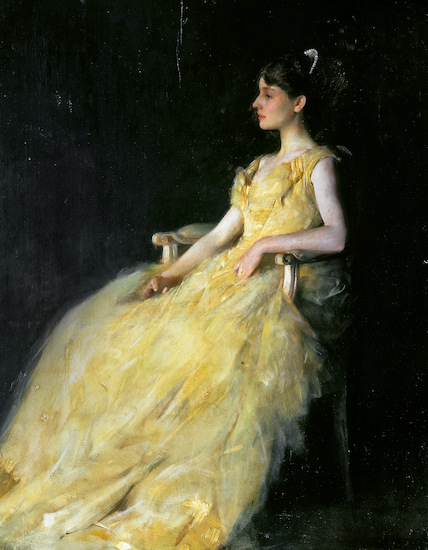 |
| Thomas Wilmer Dewing, Woman in Yellow, 1888, oil on wood, 50.2 x 40 cm (19 3/4” x 15 3/4”) © 2026 Isabella Stewart Gardner Museum, Boston (GM-21)
|
Dewing's subjects were usually women engaged in various activities, such as reading, playing music, or conversing. The viewer is not invited into these pursuits, but must remain an outsider witnessing events in an otherworldly space. In Woman in Yellow, there is no narrative, but rather an enjoyment of the composition, from the softened tones to the beautifully patterned garment. Like many American artists who adopted aspects of Impressionism, Dewing's portrait is a contrast between the detailed rendering of the sitter's head and arms, and the feathery, fluid brushwork of the yellow dress. In many ways this work resembles the work of John Singer Sargent (1856-1925) who, although he did not adopt Impressionist techniques, brought to his portraits of wealthy people contrasts in light and dark, fluid and tight brushwork, and piquant color.
Background
The British Aesthetics Movement was one of the attempts at the turn of the last century to preserve beauty and craftsmanship in a world quickly turning to industrialization. To the Aesthetics, art was not a utilitarian pursuit, but rather an outlet for enjoyment.
American artist Thomas Wilmer Dewing was influenced by these European ideas, studying in France in the 1870s. Dewing was a member of The Ten, a group of American painters who rejected the Society of American Artists for being too commercial. Rather than continue to paint in traditional styles, these painters desired to find their own styles, most of them with Impressionist overtones.
Many of The Ten are considered to be American Impressionists, known for their use of light, color, and brushwork. Dewing is more closely aligned with Tonalism, favoring a muted palette and atmospheric scenes. Eventually this style would be seen as resisting modernism, crafting dreamlike scenes depicting pursuits of the elite.
Correlations to Davis programs: Explorations in Art 2E grade 1, lessons 2.1, 2.2; Explorations in Art 2E grade 2, lessons 2.1, 2.2; Explorations in Art 2E grade 3, lessons 1.1, 1.2, 1.4; Explorations in Art 2E grade 4, lessons 1.2, 2.1; Explorations in Art 2E grade 5, lessons 1.1, 1.7; Explorations in Art 2E grade 6, lessons 1.1, 1.2, 1.4; A Community Connection 2E lesson 2.1; A Global Pursuit 2E, lesson 6.4; A Personal Journey 2E, lesson 3.2; Experience Art, pp. 33-37; Discovering Drawing 3E, chapter 7; Exploring Painting 3E, chapter 10

Comments