As an art teacher, I’ve always considered art to be central to the curriculum—a bridge that unites content areas in logical and meaningful ways. With art as a central focus, the interconnected concepts of the curriculum promote deeper understanding in students. The engaging nature of art can capture student interest, and learning becomes cumulative and holistic when art is taught as a subject within the general curriculum.
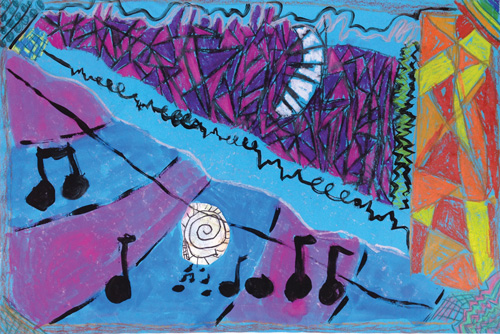
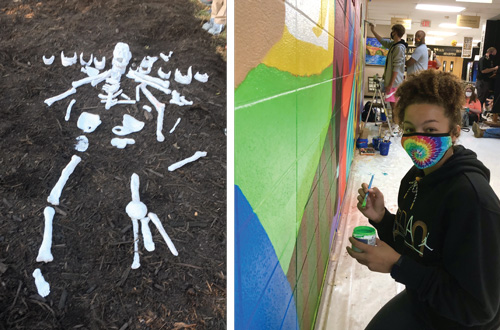
Student artwork from “Picture the Music.”Left: Student artwork from “Digging Science through Art.” Right: Student Ciaria K. applies green paint to a collaborative mural.
This month, we share engaging crosscurricular lessons developed and taught by art teachers. Let’s take a look at some of their interdisciplinary connections and content.
Art and Writing
The integration of art and writing, two equally important symbolic forms of expression, offers students a dual opportunity to explore and express ideas, feelings, and experiences. “The Art of Writing” by Jennifer Klein and Elizabeth Stuart Whitehead (p. 11) focuses on teaching writing traits through art.
Art and Science
Both art and science require that students develop skills such as careful observation, reasoning, and prediction in order to draw conclusions, justify interpretations, and predict outcomes. Works of art and the processes and tools used by artists connect with multiple science concepts. “Digging Science through Art” by Jim Dodson (p. 18) details the collaborative creation of a skeleton made from clay that was buried, unearthed, and reassembled.
Art and Mathematics
Particular mathematical concepts may best be learned through engaging experiences in art that directly correlate with math. One approach is to have students investigate the math concepts artists have deliberately chosen to incorporate in their work. “Art, Math, and M.C. Escher” by Melody Weintraub (p. 32) brings creativity to the mathematical concept of tessellations.
Art and Dance, Music, and Theater
Learning through all the arts places visual arts, media arts, dance, music, and theater as central to the general curriculum. “Picture the Music” by Linda Sachs (p. 8) describes how young students interpreted symphonic music through art.
Art and Social Studies
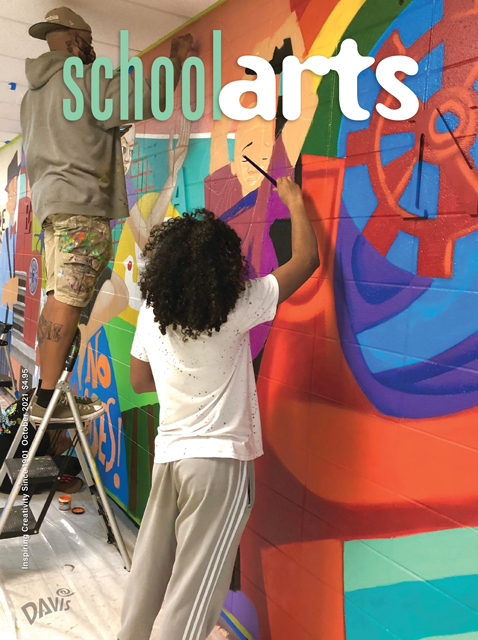
An art-centered approach to social studies promotes a wider, more inclusive definition of art that recognizes and celebrates traditions from many cultures. As art is reflective of the times and cultures in which it is created, understanding of its cultural context deepens understanding. Read the article by Elizabeth Barker (p. 15) where she shares the story of creating a collaborative school mural by working with an artist.
We hope this issue will assist you with the development of art-centered interdisciplinary lessons. What connections will you and your students make?
Art is integrated with subject areas such as math, science, writing, social studies, and music to create rich and holistic learning experiences. Young students explore cubism and develop collagraph prints inspired by a guitar study, elementary students use a Visual Thinking Strategy to evaluate art and literature, middle-school students sculpt clay bones and participate in an outdoor archaeological dig, high-school students collaborate with a professional artist to paint a mural that celebrates community and shared voices, and more.