
National Color Day: Cool and Warm Colors by Thomas Mukarobgwa (1924-1999 Zimbabwe)
The origin of National Color Day is not known. Color is something that is silent but that says a lot to everyone’s eyes. As a painter, I am obsessed with color. The paintings of Thomas Mukarobgwa are fantastic celebrations of color.
October 22 is National Color Day: art by Thomas Mukarobgwa (1924-1999 Zimbabwe)
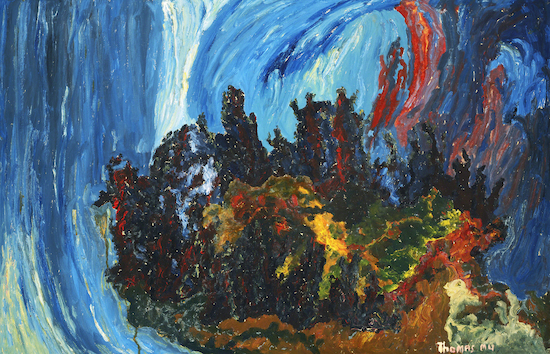 |
| Thomas Mukarobgwa, Very Important Bush, 1962, oil on cardboard mounted on composition board, 60 x 92 cm The Museum of Modern Art, New York, © 2026 Artist or Estate of Artist (MOMA-P2168)
|
Very Important Bush is typical of Thomas Mukarobgwa’s personal vision of the natural environment of Zimbabwe, which he deeply cherished. Although Mukarobgwa could pinpoint the places he had painted and explain how to reach them, his unique vision obscures them from what the typical visitor would see. Paintings like this one are actual memories drawn from the artist’s experiences in the bush.
Mukarobgwa was born in Nyanga and was a member of the Shona ethnic group. He had no art education as a child. His art training began when he was hired as a gallery attendant at the National Gallery of Zimbabwe in 1956, and the director gave him art materials, inviting him to join the nascent art school there. This school eventually became the Workshop School, which trained many future artists.
Although paintings of many of the Workshop School artists have been compared to Western artists such as Vincent van Gogh (1859–1890) and Oskar Kokoschka (1886–1980), it is doubtful that Mukarobgwa had access to images of work by these artists. He painted in bright and vibrant colors to joyfully express the interdependence of humankind and nature.
Between 1956 and 1962, Mukarobgwa focused primarily on painting. He was inspired by his native landscape and by the traditional beliefs of the Shona culture and his knowledge of local Shona life. His use of vibrant colors to emphasize nature’s forces, illuminates the Shona belief that Mwari, God of Creation, magically works through the forces of nature, represented by ancestral and animal spirits, to ensure good crops, health, and success for the Shona people.
Background
The Shona culture is an ethnic-linguistic group in southeastern Africa. Those who identify as Shona inhabit present-day Zimbabwe, southern Zambia, and west central Mozambique. Scholars believe that the Shona first appeared in present-day southeastern Africa between 200 and 1000 CE.
The Shona initially was a patrilineal society organized into disparate chiefdoms. After 1000 CE, centralized states emerged, but were not distinguishable until the 1300s when they began to trade in gold and ivory with the Portuguese and Arab cultures. The first major empire of the Shona was the Great Zimbabwe, which flourished between 1250 and 1550. The last known Shona empire, the Changamire, fell to the Ndebele and British in the mid-1800s. The modern Shona are distinguished by numerous dialect groups throughout Zimbabwe.
Correlations to Davis programs: Experience Art, lesson 1.2; Davis Collections -- African Art by Artist/Culture A-M

Comments