
Artist Birthday: Sato Koichi
Sato’s poster work shows just how fully Japanese graphic designers have absorbed Western modernist aesthetics and combined them with traditional Japanese sensibilities. Japanese poster art developed after the introduction of lithography from the earlier woodblock printed handbills called bira or ebira.
Artist Birthday for 10 December: Sato Koichi (1944-2016 Japan)
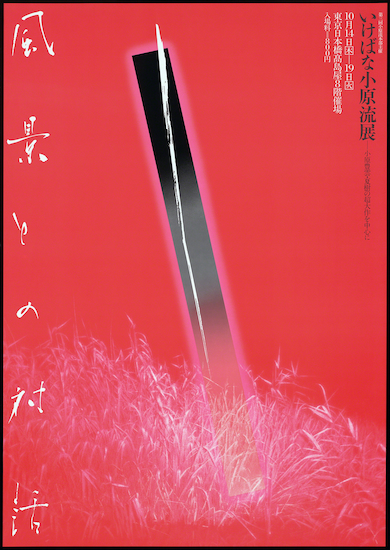 |
| Sato Koichi, Poster promoting an exhibition on traditional Japanese flower arranging (Ikebana), 1985, offset color lithograph on paper, 102.8 x 73 cm The Museum of Modern Art, New York, © 2025 Artist or Estate of Artist (MOMA-D0375) |
Sato was born in Takasaki City. He studied graphic design at the Department of Industrial Arts (Design) at the Tokyo University of Art and Music, graduating in 1968. From 1971 on he had his own freelance design firm until he took a job with Shiseido Co., Ltd. His spare, succinct design is part of the Japanese perception of communication. It is grounded in Zen Buddhism, which stresses achieving understanding through using all five senses.
Sato's poster design often exploited opposites such as traditional and modern, organic and mechanical, or East and West. The flower arrangement in this esoteric design consists of a single tall leaf on a glowing void. Sato often incorporates auras and glowing luminosity in his designs lend his work a poetic feeling that may reflect the fact that he also composes haiku.
Background
Japanese graphic design was executed almost exclusively in woodblock printing before the introduction of the first lithographic press in 1860. Japan's first lithographic printing company was established in 1872. By 1873 the use of lithography was already popular in Japan. Similar to woodblock printing, a separate stone was required for each color in chromo-lithography.The establishment of the first lithographic company was followed quickly by developing the country's first maintainable, moveable type technology for printing. By the 1880s, more publishers were using lithography than woodblock printing. By 1900, companies had been established that provided lithographic, typographic and layout services.
Offset printing is a technique in which the images on metal plate or litho stone are transferred (offset) to rubber blankets (rollers) and then to the support (paper). This process, perfected in the US in 1903, began being used in Japan after World War II (1939-1945). The main advantage of the medium is the high and consistent quality of the inked image. The process developed in 1903 is still used today by publishing and printing companies.
Between 1900 and World War II, Japanese posters, like many other genre in the arts, absorbed modernist influences from Western art, while integrating it into traditional Japanese subject matter and iconography. Even before WW II, Japanese graphic design had combined the innate Japanese aesthetic of simplicity and understatement with the Western abstraction of form to create an essentially modern style of graphic design.
Correlations to Davis programs: Communicating Through Graphic Design 2E, Chapter 1; Explorations in Art 1E, 3rd Grade, Unit 3.17

Comments