Winter White: Abbott Handerson Thayer
“Winter white” can conjure up a number of associations for people: a color of clothing worn in winter, a color of house paint, etc. For art historians like me, the mind goes right to fabulous landscapes documenting the many nuances of white in winter scenes. Boston native Abbott Handerson Thayer was part of the Boston painting scene when it transitioned from Tonalism to Impressionism between the late 1800s and early 1900s. He produced many brilliant snow scenes, but I find this one – probably in the region of Mount Monadnock near Dublin, NH -- particularly lovely, so I need to share it with you.
Winter White: Abbott Handerson Thayer
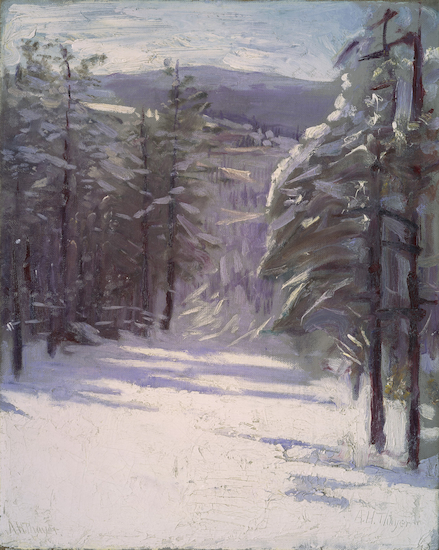 |
| Abbot Handerson Thayer (1849-1921 US) Winter Scene, 1901 or after, oil on canvas, 38.4 x 30.8 cm (15 1/8” x 12 1/8”) Image © 2026 Museum of Fine Arts, Boston (MFAB-447) |
Thayer's Tonalist aesthetic in landscapes square perfectly with his fervent love of nature. One emphasis of Tonalist painters was the depiction of atmosphere through the use of soft-edged forms that suggest an ambiguity or mystery with the landscape. The technique was called "lost-edge," and differed greatly from the broken color technique used by Impressionists, where every color stood out individually.
Thayer's landscapes represent a broad, almost abstract depiction of forms in nature that also helps heighten the emotional response to the landscape. His landscapes were non-narrative, and usually not focused on a specific place, rather than a mood evoked by a season. Although Tonalist works are often based in the pure colors of the Impressionist palette, they are muted in subtle variations of (usually) greens, purples, blues and grays that also help evoke a feeling of calm.
Background
After the Civil War (1860-1865), increasing numbers of American artists began studying painting in continental Europe rather than Britain, the common practice in the first half of the 1800s. Starting in the 1870s, these Americans were drawn to Paris rather than Rome where Impressionism was blooming. They also studied the painterly, gestural Baroque art of the Netherlands and Spain.
Many American artists embraced Impressionism and introduced it into the mainstream American art vocabulary. In contrast to the romantic realism that had dominated American art the first half of the 1800s, the last three decades witnessed American artists exploring a number of different trends, from academic revival (the "American Renaissance"), to Impressionism. There were also American Symbolists.
The influence of such religious movements as Swedenborganism -- which espoused a direct connection between nature and the divine -- and the Transcendentalism of Henry David Thoreau (1817-1862) inspired a movement that borrowed the Impressionist palette for the sake of representing nature as an emotive force: Tonalism.
Many of the Tonalist painters, like Abbott Handerson Thayer, were also keen naturalists who had an emotional connection to the nature they depicted. Born in Boston, Thayer spent his childhood in Keene, NH, near Mount Monadnock. He became an amateur naturalist whose earliest works were watercolors of animals. At 18 he moved to New York and studied at the Brooklyn School of Art and the National Academy of Design.
In 1875 Thayer moved to Paris where he studied under conservative, academic realists such as Jean-Léon Gérôme (1824-1904), where he undoubtedly acquired his academic style of figure painting, seen in his numerous versions of female angels and portraits. After settling in Dublin, New Hampshire in 1901, he began producing landscapes of the rural region he had grown up in, where his emotional attachment to the land manifested in a Tonalist and ultimately pseudo-Impressionist style.
Correlations to Davis programs: Explorations In Art 2E, grade 1, 1.2, 3.5; Explorations In Art 2E, grade 2, 1.1, 1.5; Explorations In Art 2E, grade 4, 3.2, 3.3, 4.4, 4.5, 6.4 ; Explorations In Art 2E, grade 5, 6.2; Explorations In Art 2E, grade 6, 2.1, 2.2, 2.3; A Community Connection 2E 5.4; A Global Pursuit 2E 7.2; A Personal Journey 2E 5.2, 5.4; Experience Art 4.1; The Visual Experience 4E, 8.13; Exploring Painting 3E pp. 154-161; Experience Painting chapter 6

Comments