Who Knew? Healthcare can be Art Subject Matter
Healthcare, medicine costs, insurance, etc. have been a hot topic for a long time, and a lot of the problems have consistently not changed for the better. Another thing about healthcare that has not changed is that throughout world art history, medicine, doctors, and healthcare have been the province of a genre (a category of artistic depiction) of art generally known as Ars Medica (Medical Arts). Ars Medica works range from the satiric or comical, to brutally realistic illustrations of human anatomy. Yoshitsuya Utagawa’s (1822-1866 Japan) lies somewhere in the middle of that range.
Who Knew? Healthcare can be Art Subject Matter: Utagawa Yoshitsuya (1822-1866 Japan)
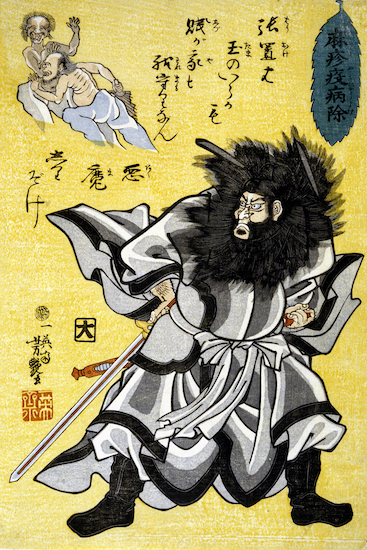 |
| Utagawa Yoshitsuya, Demon Queller Zhong Kui Preventing the God of Measels (Hashika Yakubyo Yoke), 1862, color woodcut print on paper, 37 x 26 cm (14 9/16” x 10 1/4") © 2026 Philadelphia Museum of Art (PMA-1418) |
Measles, a Western disease, was introduced accidentally into Japan in the 1500s by Portuguese traders. Periodic epidemics occurred during the following centuries. There was one such outbreak in 1862. Utagawa produced this print as a sort of protective invocation for Zhong Kui, a demon-fighting ghost deity who was part of Chinese folklore. In China, images of Zhong Kui were hung on doors and walls to keep away misfortune. Utagawa's imagining of the demon queller looks remarkably similar to depictions of actors in the guise of demons in Kabuki theater.
In 1862, as a measles epidemic swept across Japan, a genre of printed images known as hashika-e – meaning measles pictures -- developed in response. These prints provided information about the disease in text and image, as well as recommendations for how to care for measles patients. Hashika-e were also understood to have the power to ward off the disease from the home in which they were displayed.
Background
The Edo (or Tokugawa) Period (1615-1868) was the last period of traditional Japan. It was a time of peace, political stability and economic growth under the military dictatorship (shogunate) founded by Tokugawa Ieyasu (1543-1616). In the 1630s there was a complete ban on Christianity, an expulsion of all foreigners except a few Dutch and Chinese traders in Nagasaki, and, from 1633, a ban on foreign travel by Japanese.
The roughly 250 years of peace led to an expansion of the Japanese economy, particularly in commerce and manufacturing, which led to the development of large urban centers, and a rise in patronage of the arts by a broad section of Japanese society. The emergence of a well-to-do merchant class brought about the development of a dynamic urban culture that found expression in a particular genre of the traditional art form of woodblock printing, the Ukiyo-e style.
Ukiyo-e means "pictures of the floating world," floating in the Buddhist sense of the transience of earthly pleasures. The earthly pleasures depicted in these woodblock prints reflected the glittering entertainment districts (yoshiwara) of Japanese cities: its Kabuki theaters, restaurants, tea houses and shops. Eventually, however, Ukiyo-e subject matter extended into genre and folk art scenes, landscape and literary illustration. Early Ukiyo-e images were painted, but with demand high, artists turned to the woodblock medium. Initially these prints were black and white or three color. By 1764, the multiple block process (often as many as twelve for one print, with a different color printed from each block) was perfected, creating the nishiki-e or "brocade picture", so named for the wide range of colors available to an artist. They were also used as advertisement for the Kabuki theater.
Utagawa Yoshitsuya, born Kōko Mankichi, apprenticed at age 15 with Utagawa Kuniyoshi (1797-1861), an artist who is considered the last great artist of the classical Ukiyo-e style. Utagawa subsequently adopted the master's last name as was customary. He was renowned for his tattoo designs in the 1840s and 1850s, as well as his woodcut prints of warriors and legendary animals. Some of his prints contained parodies on social or political discord. When the Tokugawa shogunate introduced the Tempo Reforms in 1841, artists were banned from depicting actors and bigin-ga (beautiful woman prints). Thereafter Utagawa concentrated on images of great warriors, as well as allegorical works such as this.
Correlations to Davis programs: Explorations in Art 2E, grade 1, 3.3; Explorations in Art 2E grade 2, 4.1, 4.2; Explorations in Art 2E grade 5, 5.8, 6.4; A Global Pursuit 2E 1.1, 1.2, 7.5; Experience Printmaking chapter 4, p.73

Comments