Who Knew? Healthcare can be an Art Subject Matter II
Healthcare, medicine costs, insurance, etc. have been a hot topic for a long time, and a lot of the problems have consistently not changed for the better. Another thing about healthcare that has not changed is that throughout world art history, medicine, doctors, and healthcare have been the province of a genre (a category of artistic depiction) generally known as Ars Medica (Medical Arts). The variety of media and methods that artists employ to explore the subject of healthcare is as endless as those used in non-medical related subject matter. Many artists, like sculptor George Segal (1924-2000 US), created incredibly intimate works that document human frailty as well as resistance to illness.
Who Knew? Healthcare can be Art subject matter II
|
||
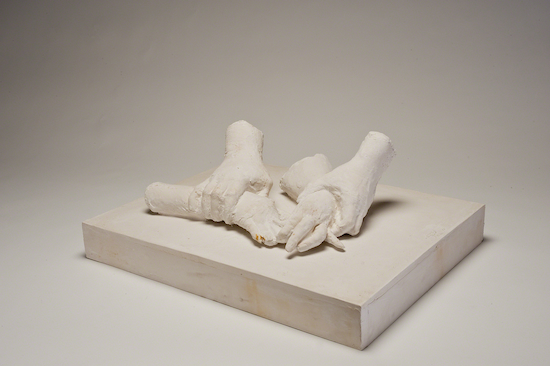
Segal's sculptures are far from the depictions of the ideal human body from ancient Greece or Rome. However, they are life-sized reproductions of actual models, and because they are not idealized like ancient sculpture, they are more relevant and accessible than "classical" art. Segal began to create "fragments" in the 1970s, and he continued the practice until the 1990s.
Initially partial casts of people's bodies, Segal began making true fragments of only individual elements of the human body such as hands, arms and even shoulders. These works, such as Physician with Arthritis Patient, are even more intimate details of everyday people, preserved forever in plaster. Physician is particularly powerfully human and compelling compared to ancient Greek sculpture, in that the subject is the hands of an "imperfect" human with arthritis. There is more than just a little irony in Segal's process of using medical gauze bandages as the basis for a work that involves the healing touch of a doctor. Unlike his anonymous cast figures of people involved in everyday activities of his work starting in the 1960s, Physician with Arthritis Patient is a powerfully empathetic work that documents a condition many, many people suffer from.
Background
The idea of mixing media, and integrating art more into everyday life itself was an integral aspect of Pop Art. Several artists sought to extend the art experience into a theater environment that led to performance pieces, or happenings. Others sought to create whole environments as a work of art. The environment as a work of art greatly extended the tradition of Dada and Surrealist manipulation of found objects from the everyday world.
Segal was born in New York to Eastern European immigrants. After World War II (1939-1945) he attended Pratt, Cooper Union and New York University to study art, receiving a teaching degree in 1949. At this time he met other artists who were interested in art that expressed themes from the real world rather than the pure abstraction of Abstract Expressionism.
Segal's early paintings of expressive, figurative canvases, were closely associated with Allan Kaprow (1927-2006), one of the first artists to stage happenings in the mid-to-late 1950s. Influenced by happenings—which emphasized people engaged in an activity of some sort—and feeling that painting limited the scope of his figural renditions, Segal turned to sculpture in 1958.
The epiphany moment for Segal's sculpture came in 1961 while teaching adult education when a student brought a box of dry plaster bandages. Segal experimented with them, making a mold of his own body, and created his first environment, Man Sitting at a Table. Segal subsequently began making plaster casts from live models engaged in everyday actions with found objects, a choice squarely within the main tenets of Pop Art.
However, Segal's works transcend the mere mockery of everyday gestures. Because of the methodology of using living people as "forms", these casts are both present and absent in one work. This became even more pronounced during the 1970s and 1980s when Segal produced fragments of people, featuring fleeting gestures and poses instead of entire people in environments. These fragments of reality are stark and ghostly, straying far from the ironic tenets of Pop Art.
Correlations to Davis programs: The Visual Experience 4E, 10.6; The Visual Experience 3E, 10.2; A Community Connection 2E, 2.1; Discovering Art History 4E 17.2; Beginning Sculpture chapter 3; Exploring Visual Design 4E, pp.178-179;

Comments