This day in History: Premier of "The Beggar's Opera" (1728)
The Beggar's Opera is a ballad opera in three acts written in 1728 by John Gay (1685-1732) with music arranged by Johann Christoph Pepusch (1667-1752). It is the only example of the once thriving genre of satirical ballad opera to remain popular today.
This Day in History 29 January: The Beggar’s Opera first performed (1728)
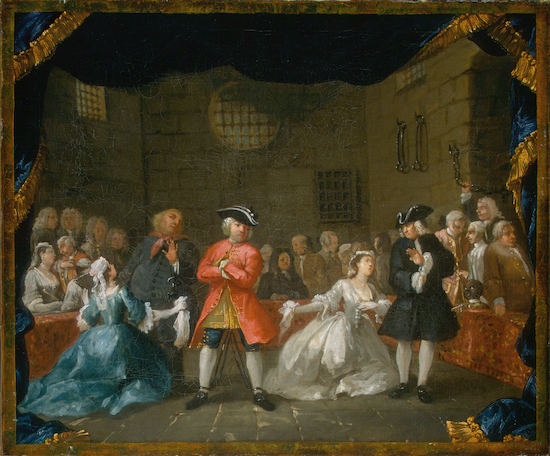 |
| William Hogarth (1697-1764 Britain) A Scene from “The Beggar’s Opera”, 1728/1729, oil on canvas, 51.1 x 61.2 cm Image © 2026 National Gallery of Art, Washington (NGA-P0250) |
In the 1730s Hogarth started painting works concerning morality in series of six, which he then translated into engravings to increase his profits. Hogarth's Calvinist upbringing came to play in his warnings about society's ills. The Beggar's Opera, first produced in 1728, was a musical indictment of the hypocrisy and bad manners of all levels of British society, from common thieves to lawyers and aristocrats. It was perfect fodder for Hogarth, whose condemnation of the abuses of the aristocracy and "respectable" middle class is mirrored in every scene of this play, the first opera to be produced without the usual recitative (singing in the rhythm of regular speech, usually in only one note), typical of the then-fashionable Italian opera.
Hogarth's style was less important to the artist (except in portraits that paid his bills) than the subject matter. Thereby, the figures in many of his societal commentaries appear cartoonish, rather than reflecting contemporary Rococo ideals of expressions of luxury and leisure. The male figures in the background of this painting are roughly equivalent to those seen in political cartoons of the day with their exaggerated features.
Background
The Baroque period in Britain was dominated by artists from Europe: Peter Paul Rubens (1577-1640), Antonie van Dyck (1599-1641), and Peter Lely (1618-1680), for example. Despite the Royal Academy's tyrannical existence in London, unlike France, British art was not dominated by artists preferred by the court. The passing of the generation of foreign Baroque painters led Britain in the 1700s to focus on regional schools of art, particularly in the areas of landscape and portraiture.
1700s painting in Britain is characterized overall by turning inward and examining British life, scientific advances, and the British landscape. It is a more restrained and less artificial Rococo style than on the Continent, and has an anecdotal quality similar to Dutch Baroque genre of the 1600s.
The humanistic ideals of the Renaissance, in which the state of the human condition became legitimate grounds for subject matter as well as style in art, predicated the development of satirical painting about follies of humankind, usually in a moralistic or religious context. Satirical art saw a further flourishing and expansion of subject matter during the 1700s, achieving their greatest form in Britain. The rigid British class system was ripe for satire, and so developed a genre of moralistic painting and prints criticizing social ills that would eventually blossom into straight out political cartoons.
William Hogarth was born the son of a humble Latin teacher in London, a Dutch Calvinist, the most conservative of the Reformation's Protestant sects. As a child, Hogarth's father went to debtors prison. The family's precarious life in bankruptcy in a rough part of London had a lasting impact on Hogarth's artistic output. A gifted draughtsman at a young age, he was apprenticed at 15 to a silverplate engraver.
By 1720 Hogarth had his own business engraving books, theater tickets and programs, broadsides, and copies of famous paintings. His copying of renowned works by such artists as Leonardo and Michelangelo most likely helped him develop his painting style, since he was in no position to receive professional training. He painted portraits and history scenes in his approximation of the then fashionable late Baroque style as a means of income.
Correlations to Davis program: AP Art History, Content Area 3 -- Early Europe and Colonial Americas

Comments