
This Day in Art History: Passing of Giotto
Giotto is largely credited as being a leader of the early (“Proto-“) Renaissance in Italian painting. His cycle of frescoes in the Scrovegni Chapel, Padua, is one of the earliest commissions for a large-scale fresco decoration that is comparable in breadth of expression and ingenuity to the frescoes of the Sistine Chapel by Michelangelo (1475-1564).
This Day in (Art) History, 8 January, 1337: Passing of Giotto (born 1266/1267, Italy)
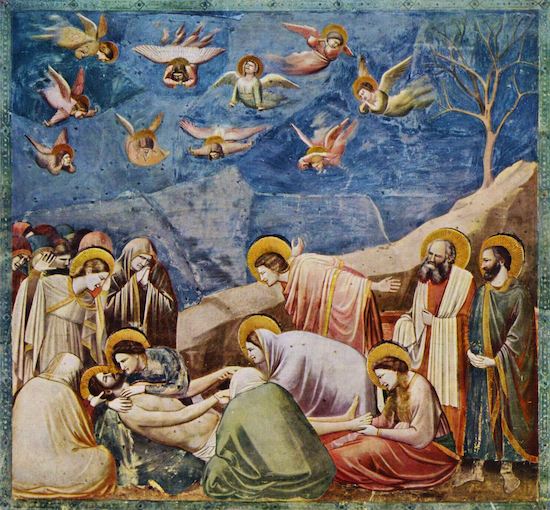 |
| Giotto, Lamentation, scene 20 from the Life of Christ series in the Scrovegni Chapel, Padua, ca 1302-1305, fresco, 2 meters x 1.9 meters, Image from the Public Domain, Davis Art Images (8s-30034) |
The groundbreaking aspect of Giotto's painting -- which dominated Florentine art in the first quarter of the 1300s -- was the monumental plasticity (sculpture-like form) of his figures, and the decidedly more human aspect of their depiction. Gone are the Byzantine/Gothic heads of combined profile and 3/4 view, as are the willowy Gothic bodies not being revealed under pointed, fluid drapery. These figures definitely have a solidity and sculptural quality new to painting.
The faces of Giotto's figures are realistically individuals. The bodies come across as volumes rather than relief-like flat patterns, although the columnar like rendition of the drapery does not technically reveal the human form in any meaningful way. The size relationship between landscape and figures is logical, as are Giotto's attempts at shading and light to aid in the plasticity of the forms. Giotto’s ability to portray human emotion in these Padua frescoes is also revolutionary, as his scenes draw in the viewer to experience these events as they look at the paintings. The frescoes encourage an empathic response to these religious stories.
Giotto's painting pointed the way to the Renaissance in its emphasis on the human individual in a logical physical, not mystical space. Remnants of Gothic mysticism persist in the misproportioned tree and fantasy rock landscape, which resembles that of manuscript illumination. The construction of depth, while more logical than previous periods, continues the Byzantine practice of axial, rather than one-point recession of forms. Axial perspective use an established single, vertical axis on which the orthogonals (lines perpendicular/at right angles to the picture plane) recede to multiple points.
Background
From the 1200s on, Byzantine artists turned their attention more to solving spatial perspective and a return to the Roman realism of early Byzantine mosaics and painting. Italian artists in the late 1200s were clearly influenced by the Byzantine efforts at spatial perspective.
Italian artists also showed an interest in convincing spatial relationships between figures and settings, logical depiction of light and shade, and more plasticity to figures. When the papacy moved to Avignon in 1309 (until 1417), Rome declined as an artistic center, but the ideas developed there persisted in the Tuscan cities of Siena, Florence, Pisa and Lucca.
By the 1200s, Florence had developed into a flourishing banking center, with trading relationships throughout Europe. The people of the Florentine city-state viewed themselves as the equal of the culture of ancient Greece and Rome. The wealthy families of Florence showered the arts with patronage, and were also patrons of scholarship and literature.
The interest in studying classical antique literature and applying it to everyday Florentine life is reflected in the development of a humanistic, realistic art that celebrated the achievements of humans, while glorifying the divine through beautiful painting, sculpture and architecture. It is little wonder why, with the explosion of artistic activity in Florence starting in the 1200s, an increasing number of artists are known by name.
Outside of Giorgio Vasari's (1511-1574) much exaggerated Lives of the Most Excellent [Artists], little is known about Giotto's training. Although Vasari mentions the Italo-Byzantine late Gothic painter Cimabue (1240-1302) as Giotto's teacher/mentor, it is not evident in Giotto's painting.
Giotto's career is often seen as one of the main heralds of Renaissance painting, although other artists at the time were exploring their expression in similar fashion. The major influences on his work seem to have been Roman sculpture and that of the Pisano family (which was based on Roman sculpture), Roman painting, and most significantly, nature.
Correlations to Davis programs: Experience Painting, Chapter 8 Wall Painting; AP Art History, Content Area 3 --- Early Europe and Colonial Americas required image

Comments