
This Day in Art History: Earliest photographic process introduced
On 9 January, 1839, Louis Daguerre (1787-1851 France) introduced his groundbreaking daguerreotype photographic process to the French Academy of Sciences. In early 1838 he had used the process to photograph the boulevard du Temple in Paris which captured the first (2) human figures photographically. The French Academy patented the process in 1839.
This Day in (Art) History 9 January: Earliest photographic process introduced
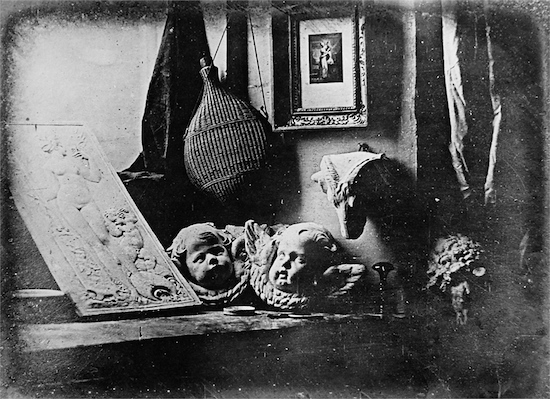 |
| Louis Daguerre, Interior of a Cabinet of Curiosities, or, Still Life with Plaster Casts, 1837, daguerreotype on silver-plated copper sheet, 16.5 x 21.6 cm Société française de photographie, public domain image (APAH-110) |
Daguerre realized that treatments of a photographic plate after, rather than before exposure could bring out a more detailed, less high-contrast image. The image that registered on the metal plate but was not yet visible is called the latent image. Daguerre found that mercury fumes heightened detail, and that common table salt could stop the light-sensitive material on the metal plate from continuing to react. This still life was his first experiment with that process.
Background
As early as the 400s BCE in China, it was observed that the reflected light rays of an illuminated object passing through a pinhole into a darkened enclosure created an inverted but exact image of the object. During the 1600s in Western Europe, a portable camera obscura was invented, and became a standard tool that helped visual artists with accurate depictions of space from a single vantage point. From the 1600s to the 1800s, the camera obscura underwent constant refinement.
From the 1600s through the early 1800s experiments with a variety of chemicals and combinations chemicals would ultimately lead to photography. In the late 1700s, British chemists tried transferring painted images on glass onto leather and paper moistened with a solution of silver nitrate. Although these early experiments failed to halt the action of light on the silver salts, they did demonstrate that it was possible to chemically transfer pictures and objects by means of light.
Nicéphore Niépce (died 1833, France) was the first to successfully transfer a positive image onto a metallic surface came, in 1827. He went from using a bitumen-coated pewter plate to silver and silver-coated copper surfaces. He also added iodine to increase the sensitivity of the silver surface. However, this process required eight hours of exposure time for a single image. Louis Daguerre perfected the process in his "daguerreotype."
Daguerre was born near Paris and was an architect's apprentice by the age of 13. At 16 he abandoned architecture in favor of apprenticing in set painting for the theater. By 1814, his painting was also well-known in the official Salon for its realistic detail and attention to the effects of light. In his painting, he used the camera obscura as an aid. His experience with large theatrical tableaus eventually led to his experiments with his "diaphanorama", a stage effect that helps change scenes by the clever lighting of multiple parallel layers of translucent canvases. This led to the Diorama, a theater in which multiple subjects were shown with daylight apparently changing or figures appearing and disappearing in half-hour shows that foreshadowed movies.
Daguerre was increasingly, however, fascinated by exploring new ways of creating images. Experimenting with phosphorescent paint to make images cast by the camera obscura glow in the dark for the Diorama, he wondered if there were chemicals that could permanently fix the image.
He learned of Niépce's work in 1827, and by the early 1830s had learned how to shorten the exposure time from 8 hours to twenty minutes, and to fix the image permanently on a polished copper plate. This occurred when he found that in 1835 that mercury vapor greatly decreased the exposure time and created a latent image on the exposed plate. The French government ultimately bought the patent for the daguerreotype in 1839.
Correlations to Davis programs: Focus on Photography 2E, Chapter 8 Still Life -- A Brief History of Still Life Photography; AP Art History, Content Area 4 -- Late Europe and Americas required image; Davis Collections -- Early Photography

Comments