Spring is Almost Here...Really
I have not shown a Childe Hassam (1859-1935 US) since around 2012, and I am such a big fan of his painting, I could not resist celebrating the coming of spring (on 20 March) with this spring green of this gorgeous little pastel work. I have tried working en plein air with pastels, and I am not going to mention what a mess I made. But we can certainly appreciate Hassam’s technique. Like the great mentor to all Impressionists Claude Monet (1840-1926), Hassam used pastels at various points in his career and to great effect, as I am sure you can see in this work.
Curator's Corner for week of 16 March: Spring is Almost Here…Really
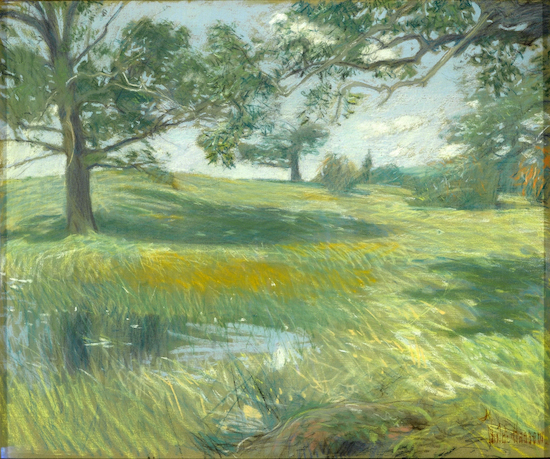 |
| Childe Hassam, Meadows, ca. 1900-1910, pastel on primed canvas, 50.8 x 61 cm (20” x 24”) Image © 2026 Brooklyn Museum (BMA-5219) |
Hassam executed his first Impressionistic pastel in 1889 while painting in Paris. Pastel was not a medium commonly used by the French Impressionists, but was expertly manipulated by Hassam in his open air (en plein air) studies. He clearly liked the medium, for from that time on he routinely exhibited pastel works starting in 1890. This work, while still displaying the broken color and importance of gesture of all Impressionism, also shows how, late in life, Hassam leaned toward more expressionistic, gestural work. The palette is right out of Monet, as is especially evident in the filmy trees in the background.
Background
During the last half of the 1800s, painting in America was dominated by the Society of American Artists in New York City and the National Academy of Design. These institutions ruled the art world, and their juries decided who did and did not show at annual exhibitions, just as European academies did. Impressionism was artistically and aesthetically controversial in the 1890s.
French Impressionist works had been introduced in exhibits in New York in the 1880s, and not well-received by critics. By the time of the 1893 Chicago's Columbian Exposition, many American painters were working in Impressionist styles, although painting at the time was still dominated by the brown-yellow landscapes of the academic artists.
Frederick Childe Hassam (1859-1935) spent some time in France during the 1880s. There he learned Impressionistic brushwork and brighter palette, and brought back knowledge of those techniques to America. While he was a member of the Society of American Artists, he naturally tended to work with those in the Society who painted in more progressive, Impressionistic styles, such as Robert Reid (1862-1959), Frank Benson (1862-1951), Edmund Tarbell (1862-1938), Willard Metcalf (1858-1925), Joseph De Camp (1858-1923), Julian Alden Weir (1852-1919), Thomas Wilmer Dewing (1851-1938) and Edward Simmons (1852-1931) who had all been in France.
The conservatives who controlled the Society, however, prevented these artists from mounting exhibits which featured Impressionist paintings. Many critics considered Impressionism a fad which lacked the grandiose objectives of "true art". Such an attitude led these ten artists to resign from the Society and form their own "academy" of Impressionism.
Their first exhibit together was March 30, 1898 at the Durand-Ruel Gallery in New York under the dubbing "The Ten". That gallery had first introduced French Impressionist works to America and was known to favor avant garde artists. Winslow Homer (1836-1910) and Abbot Henderson Thayer (1849-1921) were invited to join but declined. The group was the first in America to organize outside of the official art academies.
Hassam was born in the Boston area and trained as an illustrator and painter. By the 1880s he was painting scenes of Boston in the dark palette of the Munich school, with an emphasis on light, rendered in exacting detail. He went to Europe in 1883, spending three years in Paris, during which time he was exposed to Impressionism. His lightened his palette and he adopted the short, quick brush strokes (“broken color”) of Impressionism as well. Of all the Americans who painted in the Impressionist manner, Hassam's technique approached that of Monet the most, particularly in Hassam’s fascination with reflections in water.
Back in New York starting in 1890 Hassam painted in the Impressionist manner. Initially, he and the other Paris-influenced artists were not critically acclaimed. But, by the mid-1890s, Impressionism was a more-or-less accepted style in American art. Hassam's earliest paintings after he returned to the US in 1889 were street scenes of New York. Like the French Impressionists, Hassam delighted in showing life in a modern city and its appearance defined by light and weather conditions.
Correlations to Davis programs: Explorations in Art 1E, grade 4, lesson 4.21; Explorations in Art 2E grade 1, lessons 4.4, 4.5; Explorations in Art 2E grade 2, lessons 1.5, 1.6, 1.7; Explorations in Art 2E grade 4, lessons 3.1, 3.2, 4.4, 4.5; Explorations in Art 2E grade 5, lessons 6.1, 6.2; Explorations in Art 2E grade 6, lessons 2.1, 2.3; A Community Connection 2E lesson 5.1; A Global Pursuit 2E, lesson 7.2; A Personal Journey 2E lessons 5.2, 5.4; Experience Art, lessons 5.1, 5.2; The Visual Experience 4E lesson 8.13, p. 286; Discovering Art History 4E, lesson 15.2; Discovering Drawing 3E, p. 18; Exploring Painting 3E pp. 154-161; Experience Painting p. 62

Comments