Spring Impression by a Truly Lyrical Artist
Every so often I try to explore artists whose names have never been – as the saying goes – a “household word.” That is unfortunate, because many relatively lesser well known artists are Brilliant. One such artist, whose impression of spring this painting represents, was René Brô, an artist whose visions of nature are so beautiful, full of vibrant color, and often imaginative forms. So sit back and take a look at this beautiful work while I give you a few details about Brault’s life.
The Truly Serene Landscapes of René Brô (born René Brault, 1930-1987 France)
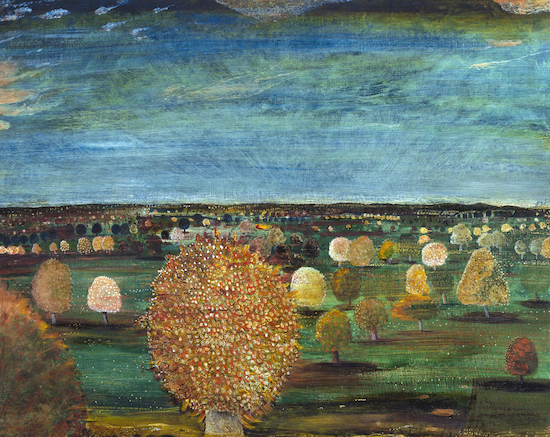 |
| René Brô, Spring Blossoms, 1962, oil and tempera on canvas, 64.7 x 81 cm (25 1/2" x 31 7/8") The Museum of Modern Art, New York, © 2026 Artist or Estate of Artist (MOMA-P2758) |
Brô painted innumerable landscapes with his signature round trees. Some of the landscapes contain figures, but the majority are Brô's contemplation on serene views of colorful plains, executed in a bright palette. Spring Blossoms was painted in the environs of Cougeron, Brô's last residence in France. His simplification of natural forms into geometric shapes contrasts sharply with the painterly horizontal bands of the landscape that reveal nuances in brush work as well as color. While the simplified tree forms are reminiscent of Klee's numerous simplifications of nature, the emphasis on depth and gradation of colors is pure Brô.
Background
René Brô was born René Brault in Charenton, near Paris. At age 14 he left school and started attending different art schools, while working as an advertising illustrator. Illustration would form the backbone of many of Brô's paintings. In the late 1940s he visited the Museum of Man and the Louvre frequently, attracted to so-called "neo-primitive" artists and ancient Egyptian art. Neo-Primitive referred to modern art that was primarily the personal fantasy of the artist like Paul Klee (1879-1940) and Jean Dubuffet (1901-1985), and also to art that was inspired by ancient and non-Western cultures.
Brô’s works at this time reflected the influence of those two artists, both of whom were greatly influenced by children's art. In 1949 on a walking trip through Italy, Brô met the Austrian artist Hundertwasser (1928-2000). Hundertwasser's painting too was influenced by children's art, but also by a utopian vision that the artist cherished after surviving the years of Nazi terror during World War II (1939-1945) as a Jew in hiding. When Brô returned to France in 1950, he and Hundertwasser painted several murals.
Brô's first one-person show was in 1954 in Paris. He went on to hold numerous solo-exhibitions during the 1960s, and he represented France at the Venice Biennale in 1964. He visited the US for the first time in 1966. He had a one person show in Scottsdale, AZ, and in New York met Andy Warhol (1928-1987). His meeting with Warhol did not inspire a change in the direction of his painting. In 1968 Brô opened a studio in Venice where he successfully exhibited in 1972 and 1977. Despite visiting Mexico, India, Nepal, New Zealand, and even Tahiti with his friend Hundertwasser, Brô's painting remained in the same serene, bucolic figurative mode throughout his career.
Correlations to Davis programs: Explorations in Art 2E grade 1, lessons 1.3, 3.4, 4.4, 4.5; Explorations in Art 2E grade 2, lessons 1.1, 1.5, 1.6, 1.7; Explorations in Art 2E grade 3, lessons 2.8, 5.4; Explorations in Art 2E grade 4, lessons 1.7,1.8, 1.9, 3.1, 4.4, 4.5; Explorations in Art 2E grade 6, lessons 2.1, 2.2, 2.3; A Personal Journey 2E lesson 5.4; Experience Art 4.1; The Visual Experience 4E lesson 8.13

Comments