Rococo Spring Fashion on Goya's Birthday
The 30th of March is the birthday of Francisco José de Goya y Lucientes (1746-1828). Instead of presenting one of his darker subjects, I opted for a fresh spring Rococo fashion statement, from the period before the French invasion of Spain when he painted in a courtly Rococo style to appeal to the Spanish nobility. Ironically, this monument to frou-frou French Rococo fashion – the tightly corseted waist, overdecoration of ribbon and chiffon, and the big hair – would go away for awhile only ten years later after the French Revolution (1789-1790s).
Artist Birthday for 30 March: Francisco José de Goya y Lucientes
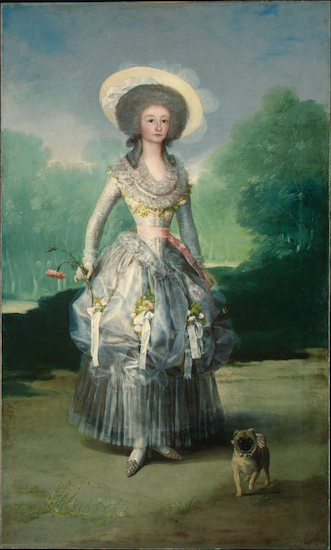 |
| Francisco José de Goya y Lucientes, The Marquesa de Pontejos, 1786, oil on canvas, 210.3 x 127 cm (82 3/4” x 50”) Image © 2026 National Gallery of Art, Washington (NGA-p0032) |
This portrait of the marquesa (marchioness in English) is Goya at the height of his mastery of the Rococo idiom. The flattering, somewhat generalized features, emphasis on elaborate clothes, and fluffy, sentimentalized nature background -- almost a theatrical backdrop -- hearken to the work of both Jean Antoine Watteau (1684-1721) and Tiepolo. This may have been an engagement portrait, the dog was a symbol of marital and religious fidelity. The carnation which she holds with awkward elegance was a symbol of the bonds of affection and love. Goya masterfully achieved a shimmering of the surfaces of the woman's outfit that reflects the influence of Velázquez's painterly rendering of materials, and the Rococo attention to details of status and luxury.
Background
When the line of the Spanish Hapsburg rules ended in 1700, the French Bourbons managed to get a the grandson of Louis XIV on the Spanish throne as Phillip V (1683-1746), after a war of succession, naturally. The Spanish had gradually lost political power and influence in European affairs, ceding the role of most prominent of the colonial powers to France.
The Spanish Bourbons ushered in, particularly under Charles III (ruled 1759-1788) the Spanish age of the Enlightenment. Economic, industrial and agricultural reforms were encouraged, and French Enlightenment philosophers such as Jean-Jacques Rousseau (1712-1788) influenced some Spanish writers and artists. The Spanish Bourbon rulers also patronized the French courtly Rococo painting style.
Francisco Goya came to maturity during the Enlightenment in Spain. At the age of 14 he began studying painting with artists José Luzán Martinez (1710-1785), who painted primarily religious works in a Baroque style that was much imitated among colonial Mexican artists. In Madrid Goya also studied under Francisco (1734-1795) and Ramón (1746-1793) Bayeu y Sublas. Francisco specialized in Baroque religious scenes, but his portraits were painterly, tenebristic, and realistic. Ramon specialized in genre scenes in the Rococo spirit of both common people and the well-to-do alike.
In Madrid, Goya could not help but be influenced by the Baroque master Diego Velázquez (1599-1660). In 1770 he visited Rome where he was greatly impressed with the work of the Italian Rococo painter Giovanni Battista Tiepolo (1696-1770). Goya's introduction to royal patronage started in 1774 when he was tasked with producing cartoons for tapestries to decorate the royal residences. He painted 63 cartoons in a playful Rococo style that featured, like Ramon Bayeu y Sublas, rich and poor alike in genre scenes. His work decorated the palaces at El Escorial and El Pardo.
Between 1785 and 1788 he painted portraits of numerous members of the nobility in a flattering Rococo style. Although Goya was appointed court painter to the new king Charles IV (ruled 1788-1808), his Rococo period was short-lived. The war with France from 1793 on and Napoleon's invasion of Spain in 1808 shattered Goya's bubble, and it was subsequently reflected in his artwork.
Correlations to Davis programs: Explorations in Art 2E grade 1, lessons 2.1, 2.2; Explorations in Art 2E grade 2, lessons 2.1, 2.2; Explorations in Art 2E grade 3, lessons 1.1, 1.2, 1.4; Explorations in Art 2E grade 4, lessons 1.2, 2.1; Explorations in Art 2E grade 5, lessons 1.1, 1.7; Explorations in Art 2E grade 6, lessons 1.1, 1.2, 1.4; A Community Connection 2E lesson 2.1; A Global Pursuit 2E, lesson 6.4; A Personal Journey 2E, lesson 3.2; Experience Art, pp. 33-37; Discovering Art History 4E, lesson 12.2; Discovering Drawing 3E, chapter 7; Exploring Painting 3E, chapter 10

Comments