
National Walking Day: Art by Henri Gaudier-Brzeska (1891-1915 France)
Henri Gaudier-Bzeska was an early abstract sculptor who leaned in the direction of Neo-Primitivism, a style so named for the non-Western cultures that influenced Western artists. National Walking Day was initiated by the National Heart Association as the first Wednesday of April in 2007 to encourage people to walk 30 minutes a day to improve health.
April 1 is National Walking Day: Art Henri Gaudier-Brzeska (1891-1915 France)
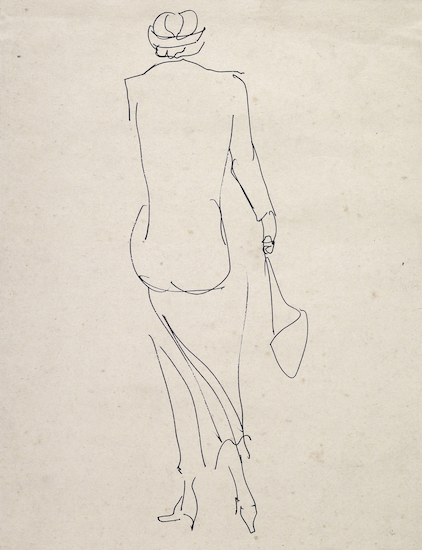 |
| Henri Gaudier-Brzeska, Woman Walking, 1912/1913, ink on paper, 25.4 x 19.7 cm Image © 2026 Buffalo AKG Art Museum, Buffalo, New York (AK-2334) |
Gaudier-Brzeska's association with Vorticism enabled him to get several of his drawings published in Rhythm magazine in 1912. The drawings the artist produced from 1911 to 1912 are indicative of his inclination to reduce form to the utmost simplicity. The deft description of this walking woman with just a few contour lines foreshadow's the artist's innate ability in sculpture to describe the fundamental nature of form with just a few, sure chisel strokes.
Background
In the latter half of the 1800s in Western art, the French Impressionist movement was a revolution in the centuries-old traditions of western, academic art. Instead of following the academic formulas for subject matter and style, Impressionists favored "art for art's sake," focusing on capturing the fleeting effects of light on the local color of forms in nature. This focus also dispensed with traditional techniques of painting, discarding both study drawings or underpainting. Impressionists were also the first group of Western artists to incorporate ideas from non-Western art sources, such as the composition in Japanese woodblock prints.
Artists who followed the Impressionists also sought new sources for inspiration to separate their art from the worn-out, conservative, classically-oriented formulas of the "official" art world. Artists such as Paul Gauguin (1848-1903) felt that artists should listen to the most basic, "savage" artistic instincts in order to reach a unity of form and subject. He travelled to the South Pacific in search of new and exciting subject matter. Many of the first generation of abstract artists in the early 1900s looked to non-Western, so-called "primitive" art for inspiration, including the art of Africa, Oceania, and ancient cultures of the Americas.
The search for a "primitive" form of artistic expression had particularly strong impetus in sculpture. Henri Gaudier-Brzeska was one of the leading "primitivist" sculptors of the early 1900s. His rough-hewn sculptures combined Cubist and organic forms with expressionistic character of surface. His body of work is all the more remarkable because of his lack of formal training and his youth. He was born Henri Gaudier in Saint-Jean-de-Braye near Orleans, and moved to Paris in 1910 when he decided to be a sculptor. He is not believed to have had any training in drawing or any other fine art before that time, but is thought to have settled on sculpture as a vocation inspired by his father's work as a carpenter and woodworker.
In 1910 he met Sophie Brzeska whose last name he ultimately appended to his own, and the two moved to London in 1911. In London Gaudier-Brzeska lived in extreme poverty with no money for sculpture materials, and with little perception of the latest trends in sculpture. He joined the Vorticism movement, a short-lived British adaptation of a combination of Cubism and Futurism.
Vorticism introduced Gaudier-Brseska to Cubist reduction of form to geometric shapes, and, more importantly, introduced him to the established primitivist modernist sculptor Jacob Epstein (1880-1959). Epstein was notorious in Britain for his rejection of the stale, classical style of sculpture in favor of African sculpture, Oceanic art, and ancient Mesopotamian sculpture. Gaudier-Brzeska studied works from these cultures at the Victoria and Albert Museum.
Gaudier-Brzeska died in World War I (1914-1918), but his small body of works had enormous influence on subsequent abstract sculpture in Britain. He was particularly influential on Henry Moore (1898-1986) and Barbara Hepworth (1903-1975).
Correlation to Davis program: Exploring Visual Design 4E, Chapter 1 Line, Studio Experience

Comments