National Umbrella Day: Utagawa Kuniyoshi (1797-1861 Japan)
The origins of this recognition day is uncertain, but Umbrella Day has been celebrated since 2004. The origins of the contemporary, waterproof umbrella date to the 1700s in France, while umbrellas as protection from sun have been around since ancient Egyptian times, almost 4000 years. “Umbrella” comes from the Latin word umbra which means “shade”, alluding to the umbrella’s initial use as shade from the hot sun (as in “parasol”, or from the Italian para meaning defend and sole meaning sun).
February 10, 2026 is National Umbrella Day: Art by Utagawa Kuniyoshi (1797-1861 Japan)
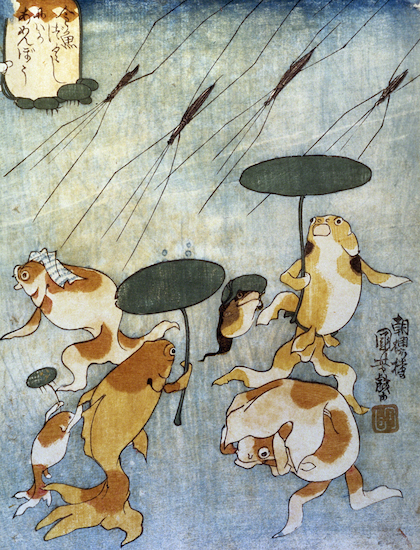 |
| Utagawa Kuniyoshi, Frog, Goldfish, and Waterbugs, print from the Comic Goldfish series, 1839-1842, color woodcut print on paper, 23.2 x 17.3 cm Image © 2026 Philadelphia Museum of Art (PMA-881) |
The Comic Goldfish series is a clever 1800s updating of a subject that had been around in Japan for 800 years – the tradition of depicting animals acting like human beings. Kuniyoshi humorously used all elements of nature to depict his goldfish acting like humans in a rainstorm. In his take, the rain is in the form of water bugs, and the goldfish hold lily pads over the heads as umbrellas. The waterbugs in the background are a clever parody of the style of Ukiyo-e depiction of rain as a series of parallel downward flowing lines. They must have been a headache for the woodblock carvers!
Background
The Edo Period (1615-1868) in Japan was ruled by the Tokugawa family military dictators who isolated Japan from all foreigners. It was, however, a period of a flourishing in all of the arts, particularly the art form of woodblock print making. Unlike the nobility, the middle class desired to see scenes of their everyday experiences and pleasures, rather than esoteric, contemplative landscape paintings that were the province of the wealthy. The woodblock color prints that developed to document the dynamic urban life of Edo period cities were called ukiyo-e.
Ukiyo-e means "pictures of the floating world," floating in the Buddhist sense of the transience of earthly pleasures. The earthly pleasures depicted in these woodblock prints reflected the glittering entertainment districts (yoshiwara) of Japanese cities: its Kabuki theaters, restaurants, tea houses and shops. Eventually, however, Ukiyo-e subject matter extended into genre scenes, landscape and literary illustration. Early Ukiyo-e images were painted, but with demand high, artists turned to the woodblock medium. Initially these prints were black and white or three color. By 1764, the multiple block process (often as many as twelve for one print, with a different color printed from each block) was perfected, creating the nishiki-e or brocade picture, so named for the wide range of colors available to an artist. They were also used as advertisement for the Kabuki theater.
The Ukiyo-e style was also a vehicle for subjects outside of the "floating world." The words kachō-e and kachō-ga are usually translated as “pictures of birds and flowers”, but they may also be used to describe the broader category of nature prints that includes fish, animals, and insects. It is a descendant of the "animals acting like people" paintings from the Heian period (794-1185), treating the subject in the same light-hearted manner.
Utagawa Kuniyoshi is often considered the last great master of the classic Ukiyo-e style (late 1700s to early 1800s). Renowned for his kabuki and figures of beautiful women, he also did numerous kachō-ga. Born Yoshisaburō, the son of a silk-dyer, he showed a passion for drawing as a young person. At fourteen he was apprenticed to the founder of the distinguished Ukiyo-e Utagawa School, Toyokuni (1769-1825). Upon "graduating" from the Utagawa workshop, as tradition dictated, he adopted the Utagawa as a last. He also adopted the name Kuniyoshi kuni from his master’s name, and yoshi from his own given name.
Correlation to Davis program: Explorations in Art 1E, grade 2, Unit 4 Picture Stories, 4.22

Comments