
National Let's Laugh Day
Although the origin of Let’s Laugh Day is unknown, it has been celebrated since 2019 as a way of stressing “laughter is the best medicine.” The national day stresses the benefit of laughter for health, and even encourages people to experience a minimum of two “belly laughs” per day. One ancient culture whose art reflects this human trait in numerous sculptures are the Totonac of ancient Mexico
March 19 is National Let’s Laugh Day: Art by Totonac Culture (flourished ca. 100-1000 CE, Mexico)
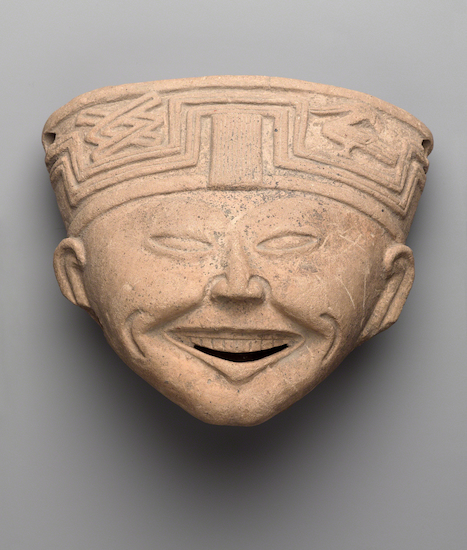 |
| Totonac Culture, Mexico, Head of a Laughing Man, ca. 600-700 CE, ceramic, 15.2 x 17.1 x 10.8 cm. Image © 2026 Brooklyn Museum (BMA-5268) |
Like many of the other Mesoamerican cultures, including the neighboring Maya, ceramic arts were a significant form of sculpture for the Totonac. The most important objects were vases and jars meant to hold offerings in tombs, and incense burners which were used during religious and burial ceremonies. Like most Pre-Columbian art, most objects come from grave sites. Large ceramic heads such as this are typical of the Late Classic Period (ca. 600-900 CE) among the Totonac, and resemble the ornamental ceramic heads from incense burners for use in Teotihuacán burials.
Incense burner heads are a combination of molded sections and applied strips of decoration whereas these Totonac "laughing heads" are a single molded piece. Although these laughing heads resemble the "laughing baby" figures of the Olmec culture (flourished ca. 1500 BCE-100 CE), they are stridently more realistic, almost eerily so. In many versions, both male and female, the tongue is protruding as if in a full-bellied laugh. The purpose of this iconography is unknown, although it is possible such small objects as this head may have been intended to be worn around the neck as a pendant, as indicated by the holes in the sides of this hollow, unglazed head. It may originally have been painted in bright colors.
Background
During the pre-Hispanic period in Mexico, the region that now constitutes the modern-day state of Veracruz was inhabited by four indigenous cultures. The Huaxtecs and Otomíes occupied the north, the Totonacs were in the north-center, and the Olmecs, one of the oldest cultures in the Americas, dominated the south between 1300 and 400 BCE. By the 400s BCE, the domination of the Olmec culture waned as central Mexican and Mayan cultures emerged and grew.
The Totonac (Tutunacu) occupied the area known as Totonacapan, stretching throughout central Veracruz and including the Zacatlan district of present day state of Puebla. Totonac territory contained almost fifty towns with a combined population of about 250,000 people. They spoke four dialects, some of which are active languages in the present day. The two major cities were the capital Cempoala, and the beautiful El Tajín. The culture began to build these cities after the fall of nearby Teotihuacán in the 700s CE. The Totonacs claimed to have been the elite of the Teotihuacán culture. The Totonac culture spread northward along the Gulf Coast, having close contact with many of the different Mayan culture groups. By 900 CE, the Totonac led a confederation of cities, but, in 1200 El Tajín was depopulated by the Chichimec invaders.
Around 1450 the Totonac provinces were conquered by the Aztec, whom they served until the conquest of Mexico by the Spanish. In 1519 the Totonac supplied soldiers to the Spanish in order to help conquer the Aztec overlords. Unfortunately, after the Aztecs were defeated, the Totonac were assimilated in the Spanish conqueror's culture, simultaneously being forcibly Christianized. To the current day, it is estimated that about 90,000 people in Mexico speak one of the distinctive Totonac dialects (they were not Nahua-speaking people like the cultures of the highlands (Maya, Aztec, etc). There are an estimated one million Mexican people who can claim Totonac heritage to the present day.

Comments