
National Hat Day: Art by Tom Price
Since at least 1983, schools, libraries, and museums have observed National Hat Day. People are invited to wear their favorite type of hat. The date also commemorates the day in 1797 when the first top hat made its appearance in London.
National Hat Day, 15 January: Art by Tom Price (1857-1927, Haida Culture, British Columbia)
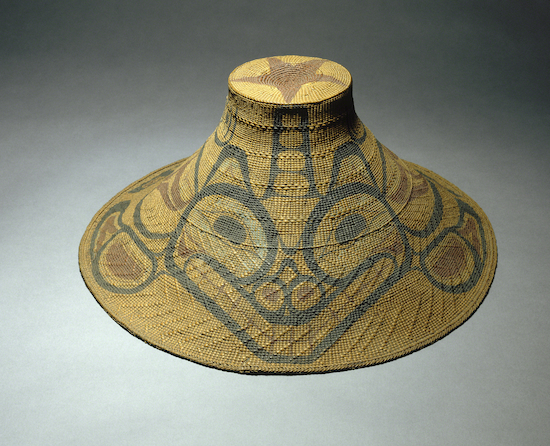 |
| Tom Price, Hat, late 1800s, spruce root, pigment, 40.6 x 40.6 x 111.8 cm Image © 2026 Brooklyn Museum (BMA-5189) |
Tom Price was a Haida born on Anthony Island. He was a fisherman and boat builder, and also a carver in argillie, a hard, compact sedimentary rock made of hardened clay and silt. He took the name Ninstints around 1906.This hat is decorated with the symbol of a prominent Haida clan. The design is of Tts’aamus (Sea Snag), the personification (the assigning of human or animal features to a non-living object) of submerged driftwood that comes to the surface and causes damage to canoes when the occupants are not paying attention. The red ovoid form and the red star on the crown are both a part of Tom Price’s personal, signature style, identifying that artist as the painter of the hat. The supernatural figure of the Sea Snag is common within Haida culture. Associated with Sea Bear and Sea Wolf, the Sea Snag represents responsibility and protection. Sea Bear and Sea Wolf are symbols linked to the beginning of the world and the formidable nature of the ocean. Hats such as these can be made only by artists authorized to paint secret clan symbols. The colors are usually restricted to black and red with the occasional addition of blue-green, as seen in this example.
Basketry is an art form that dates from the earliest periods of North American aboriginal cultures, particularly in the West and Northwest. There are three basic techniques found in historic Indian baskets dating from ancient times: plaiting, twining, and coiling. This basket is an example of twining. In twining, two or more weft elements are twisted around the warps to create a pattern.
Background
The actual period of when the islands off western North America between Alaska and British Columbia were inhabited has been intensely debated. Recent archaeological excavations (2014) in Juan Perez Sound off Queen Charlotte’s Island suggest that the Haida inhabited the area as far back as 12,000 BCE. At that time, the mainland of British Columbia was joined to the island.
The Haida were able to thrive in the rough terrain off British Columbia for centuries by taking advantage of the abundant wildlife on both land and sea and the cedar forests. Good stewardship of the environment and a respect for nature is a hallmark of Haida culture. They established trade links with neighboring First Nation communities. The stable and thriving culture developed by the Haida was based on a class and ranking system of two main clans, the Raven and the Eagle.
Before contact with Europeans, the Haida, expert seafarers, occupied more than 100 settlements from southern Alaska to British Columbia. First contact was with the Spanish in 1774 and then the British in 1787. The sovereignty of the Haida ended once the British in Canada realized the value of sea otter pelts to Chinese trade. By 1879 their numbers had been decimated by European-introduced disease, alcohol, and guns from 7000 on first contact to only 700 in two settlements. The current population of Haida is between 4500 and 5000 divided between Skidegate and Old Massett.
Correlations with Davis programs: Experience Art Unit 4.3; Davis Collections – Canadian Artists

Comments