
National Apple Tree Day, Jan. 6: Worthington Whittredge
There’s no shortage of gorgeous 1800s American paintings of apples at the Museum of Fine Arts in Boston, but this is one of my favorite to celebrate National Apple Tree Day. National Apple Tree Day was originally thought to have been founded to celebrate a 200-year-old apple tree on the East Coast of the US. Since then it has evolved to celebrate all American apple trees, one of the most important fruit trees in this continent.
January 6 is National Apple Tree Day, art by Worthington Whittredge (1820-1910 US)
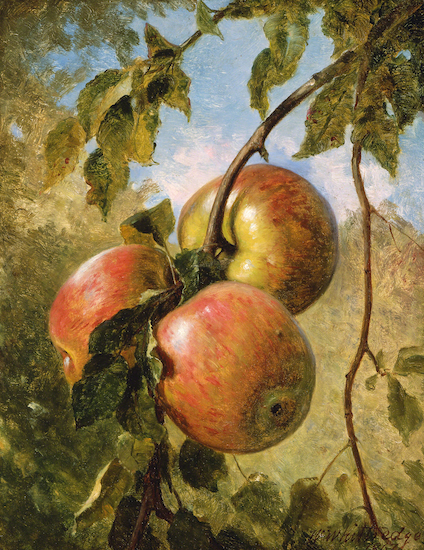 |
| Worthington Whittredge, Apples, 1867, oil on canvas, 38.7 x 30.8 cm Image © 2025 Museum of Fine Arts, Boston (MFAB-148) |
After Whittredge returned to the US in 1859, he began to make journeys into the wilderness of the Catskills and White Mountains like other Hudson School Artists. He showed the same dominant interest in the minutiae (minute details) of nature much like Frederic Church (1826-1900).
Whittredge, unlike Church, did not do endless detailed studies thereafter producing a canvas in the studio. He painted meticulous details of nature that were contrasted by loosely painted backgrounds on the spot outdoors, as he had learned from the French Barbizon painters (who had influenced the Impressionists to do the same thing).
These extremely detailed apples are framed by hazy hills and quickly rendered trees in an obvious study for a larger painting. He had acquired an inquisitive nature about the natural bounty of American fruits growing up in Ohio, at the time a center of horticultural studies in the US. Such sketchily rendered works also went against his training in Düsseldorf, which emphasized the influence of the painterly though tight realism of Baroque painting.
Background
After victory in the American Revolution (1775-1783), as Americans cleared and settled land farther and farther to the west, and the country became prosperous, American art expanded the rather limited scope of its painting and sculpture. Landscape, still life, and genre scenes all joined the ranks of accepted subject matter in American art.
Landscape and nature paintings were particularly popular, as Americans desired not only an indigenous American painting school, but also wished to see the natural beauty of their new country documented / celebrated in art. In landscape painting, the Hudson River School was the result of the "discovery" of the beauty of the American wilderness. The "school" was represented by a variety of approaches to a sort of romantic realism.
Born in Springfield Ohio, Whittredge painted landscapes and portraits in Cincinnati as a young man. He traveled to Europe in 1849 to further his training. He studied in Düsseldorf where there was an aesthetic in painting nature that was comparable to the American aesthetic of meticulous record of natural details. He also traveled to Italy and France. In France he was impressed by the landscape painters of the Realist Barbizon "school." These artists espoused painting nature outdoors on the spot.
Whittredge returned to the US in 1859, establishing a studio in New York. From there he made frequent trips up the Hudson River Valley to the Catskills, and to the White Mountains to record the northeastern landscape. He established himself as a member of the Hudson River School, associating with Albert Bierstadt (1830-1902) -- whom he had met in Düsseldorf -- and John Frederick Kensett (1816-1872). In 1865 he traveled across the Great Plains to the Rocky Mountains. He was deeply impressed with the vastness and emptiness of the Great Plains.

Comments