More Winter White: Keisai Eisen (1790-1848 Japan)
I continue to celebrate winter, my second favorite season after autumn, with yet another snow scene. Eisen Keisai is typical of the artists of the classic Ukiyo-e period (late 1700s to early 1800s), in that they produced not only prints of middle-class city life in urban Japan (such as the Kabuki theaters, restaurants, and entertainment venues/yoshiwara), but also branched out into prints of nature, landscapes, genre, and history subjects.
More Winter White: Keisai Eisen (1790-1848 Japan)
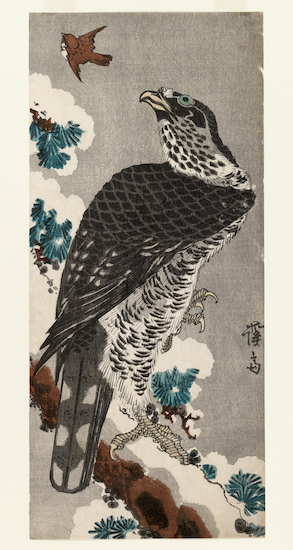 |
| Keisai Eisen, Hawk on a Snowy Branch Eyeing a Sparrow, 1830, color woodcut print on paper, 33.7 x 15.2 cm (13 1/4" x 6”) Image © 2026 Brooklyn Museum (BMA-2612) |
Despite his renown as a re-interpreter of the "beautiful woman" (bijin-ga) genre of the Ukiyo-e print style, Keisai was also obliged to produce landscape series, and bird-and-flower prints. The bird-and-flower genre (kacho-ga) was an ages old subject inherited from China, where it evolved during the 900s CE as a popular format. It became popular in Japan during the Kamakura Period (1185-1333), and eventually – in Japanese art -- came to comprise all sorts of animals combined with trees and flowers.
Hawk in Japanese is taka. A hawk seated on a snowy pine bough is matsutaka-zu ("pine-hawk painting"). It was a common sight in Japan in winter when hawks hunted other migratory birds. The hawk was also an auspicious New Year creature, especially if dreamt of first thing in the New Year. The hawk with upturned head like this was a motif established by the great master of the Ukiyo-e style in the earlier 1800s, Hokusai (1760-1849). This shape of intermediate-sized prints like this is called aiban.
Background
The Edo (or Tokugawa) Period (1615-1868) was the last period of traditional Japan. It was a time of peace, political stability and economic growth under the military dictatorship (shogunate) founded by Tokugawa Ieyasu (1543-1616). In the 1630s there was a complete ban on Christianity, an expulsion of all foreigners except a few Dutch and Chinese traders in Nagasaki, and, from 1633, a ban on foreign travel by Japanese.
The roughly 250 years of peace led to an expansion of the Japanese economy, particularly in commerce and manufacturing, which led to the development of large urban centers. The emergence of a well-to-do merchant class brought about the development of a dynamic urban culture that found expression in a particular genre of the traditional art form of woodblock printing, the Ukiyo-e style.
Ukiyo-e means "pictures of the floating world," floating in the Buddhist sense of the transience of earthly pleasures. The earthly pleasures depicted in these woodblock prints reflected the glittering entertainment districts (yoshiwara) of Japanese cities: its theaters, restaurants, bars and shops.
Eventually, however, Ukiyo-e subject matter extended into genre scenes, landscape, animals and literary illustration. Early Ukiyo-e images were painted, but with demand high, artists turned to the woodblock medium. Initially these prints were black and white or three color. By 1764, the multiple block process (often as many as twelve for one print, with a different color printed from each block) was perfected, creating the nishiki-e or brocade picture, so named for the wide range of colors available to an artist.
Keisai was born in Edo (Tokyo), the son of a Kanō School painter. Although his training as a printmaker is undocumented, he is thought to have been influenced by the great Ukiyo-e landscape master Hokusai (1760-1849), and by the specialist in beautiful women prints (bijin-ga) Kikugawa Eizan (1787-1867). Keisai is primarily known as a producer of prints of bijin-ga of the Bunsei period (1818-1830), many of which are now considered masterworks for their increased realism and complex contrasts of patterns of the gawdy fashions of the late Edo period.
Correlations to Davis programs: Explorations in Art 2E, grade 1, 1.8, 1.9; Explorations in Art 2E, grade 2, 3.1, 3.2, 3.3; Explorations in Art 2E, grade 3, 2.5, 5.1, 5.2; Explorations in Art 2E, grade 4, 4.1, 4.3; Explorations in Art 2E, grade 5, 4.4, 4.5, 4.6; Explorations in Art 2E, grade 6, 2.8, 2.9; A Community Connection 2E 4.5; A Global Pursuit 2E 7.3, 7.5; A Personal Journey 2E 5.3; Experience Art 4.1, 4.2; Experience Printmaking pp. 72-73; Discovering Drawing 3E chapter 8

Comments