
March is Women's History Month
There was a period in the early 1900s, before World War I (1914-1918) when many American artists looked to European painting for inspiration and modern modes of expression, including abstraction. Even though the fervor for modernism cooled after the war, many committed modernist artists – including many women like Marguerite Zorach (1887-1968 US), persisted in furthering the development of early American modernism, long before Abstract Expressionism came along.
March is National Women’s History Month
 |
|
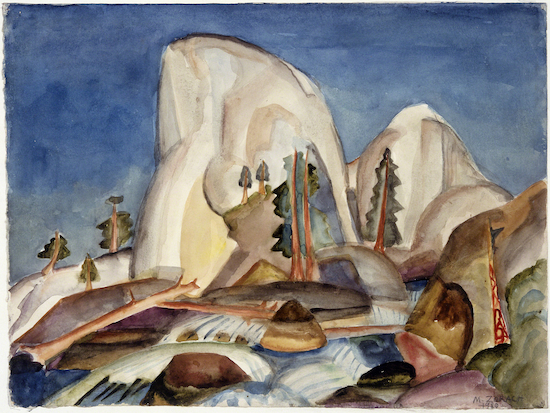
| Marguerite Zorach, Half Dome, Yosemite, California, 1920, watercolor over pencil on paper, 25.4 x 34 cm (10” x 13 3/8”) The Brooklyn Museum, © 2026 The Zorach Collection, LLC |
Returning to Fresno from Paris in 1912, Zorach camped with her family in the Sierra Madre and did a series of paintings of that area. The following year, she returned to NYC, married Zorach, and lived in Brooklyn for her remaining years. She was one of the few young artists to introduce Fauvist and Cubist styles to the U.S. between 1910 and 1920. The Zorach's made another trip to Yosemite in 1920.
Zorach displayed an angularity and flatness of form derived from Cubism to which she was exposed at the Armory Show of 1913 in which both she and her husband exhibited. Although her work revealed the faceting of Cubism, her forms never dissolved to the extent of the French Cubists, or even her friend Max Weber (1881-1961), whose Cubist work had a major impact on her style in the 1920s.
Background
Throughout the history of American art, up until the mid-1900s, American artists looked to European painting and sculpture movements for inspiration. At first it was England, then later Italy and Germany. Starting in the 1860s, Paris became the main destination for American artists who wished to learn a continental style.
Paris became the center of the progressive art world during the 1870s, when the Impressionist movement blossomed. Thereafter it maintained its primacy as the avant-garde capital of western art until World War II (1939-1945).
American artists at the turn of the 1900s flocked to Paris, attracted by the revolutionary spirit in artistic experimentation. This was particularly true after the Armory Show of 1913 which introduced American public to European modernism such as Expressionism, Dada and Cubism for the first time.
Marguerite Zorach was one of the American artists who exhibited her work at the Armory Show. Born in California, she showed artistic talent by the age of 3. She was one of the first women admitted to Stanford University in 1908, and shortly after enrolling there, she moved to Paris. While studying there for four years, she befriended Fauvist pioneer Henri Matisse (1869-1954) and Cubist pioneer Pablo Picasso (1883-1971).
By 1912, when she returned to the US, she had adapted a Fauvist painting style. It was tempered by the planar simplification of Cubism, although not to the degree of French Cubism. She actively promoted the work of those foreign styles in the US.
During the 1920s, she became increasingly involved with fiber arts, especially tapestry and needlework. This came in handy during the Great Depression (1929-1940) when commissions for paintings were few and far between and she was able to sell clothing she made. She also painted murals for the Federal Arts Project.
Correlations to Davis programs: Explorations in Art 2E grade 1, lessons 4.4, 4.5; Explorations in Art 2E grade 2, lessons 1.5, 1.6, 1.7; Explorations in Art 2E grade 4, lessons 3.1, 3.2, 4.4, 4.5; Explorations in Art 2E grade 5, lessons 6.1, 6.2; Explorations in Art 2E grade 6, lessons 2.1, 2.3; A Community Connection 2E lesson 5.1; A Global Pursuit 2E, lesson 7.2; A Personal Journey 2E lessons 5.2, 5.4; Experience Art lessons 5.1, 5.2; The Visual Experience 4E lesson 8.13; Discovering Art History 4E, lesson 15.2; Exploring Painting 3E pp. 154-161

Comments