March 2026 is Women's History Month
I have always maintained that there is no period in history anywhere in the world when women artists did not play a significant role in the world’s cultures. Up until about fifty years ago, however, major art history textbooks did not do a very adequate job in documenting the rich history of women artists. The Italian painter Lavinia Fontana (1552-1614) had a successful professional life as an artist during the late Renaissance/early Baroque period.
National Women's History Month March 2026: Art by Lavinia Fontana (1552-1614)
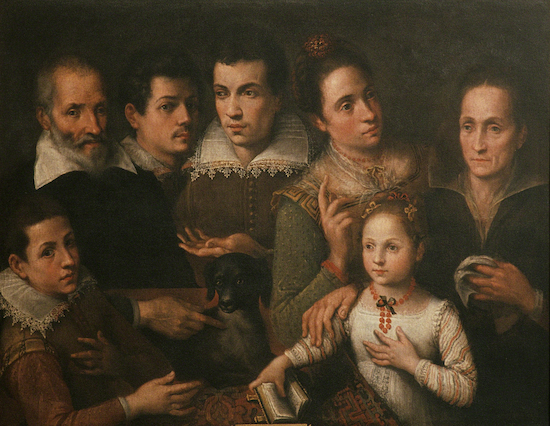 |
| <Lavinia Fontana, Family Portrait, 1598-1600, oil on canvas, 85 x 105 cm (33 7/16” x 41 5/16”) Pinacoteca di Brera, Milan, image © 2026 Dr Ronald Wiedenhoeft / Saskia, Ltd. (MIF-1223) |
This unknown family is arranged by generations and then gender. The older man in the upper left is the deceased head of the family, while the woman in the right corner is his widow. Fontana only worked on an accurate likeness of these sitters' faces -- the poses of their hands and bodies most likely came out of a sample book of elegant stock poses. The figures' arrangement in a crowded group close to the picture plane with the vague, dark background lends the work a certain amount of tension to the composition -- a hallmark of Mannerism -- although the figures all have a quiet dignity.
Background
In the West, between the 1400s and 1600s, little changed in the education of women as artists. Through the 1300s, the most educated women were members of convents, practically the only place where women could be artists, copying and illustrating books. Women with the drive to be artists had to train with male relatives who were established artists. They were denied membership in the guilds that ensured patronage to artists. In spite of these restrictions, however, some women managed to become widely-respected artists.
Because women were denied apprenticeships with non-family member artists, their body of work was limited to what a male relative taught them. This often meant that they would repeat the specialty of that relative, be it in still life, portraiture, or genre painting, all considered inferior subject matter to religious or history subjects by the established artists' guilds.
As education expanded for men in the 1400s, so it did as well for women. Artists were now recognized as an honorable profession rather than simply a craft. With the expansion of the printed book, women were able to read treatises on women artists in the ancient world and aspire to the same profession, since everything ancient (Greece and Rome that is) was considered paramount during the Renaissance. Although it was still considered "inappropriate" for educated women to receive the same artistic training as men, increasing numbers of women are now known to have begun pursuing careers in painting and sculpture by the middle of the 1500s.
Born in Bologna to fresco artist Prospero Fontana (1512-1597), Lavinia Fontana was one of the first women artists to seek commissions. She produced not only portraits, but also religious art, narrative and history subjects. She was one of the first Italian women artists to earn fame and commissions from throughout Italy. Unlike most women artists of the Renaissance, Fontana was encouraged in her art by her father who taught her how to paint. She flourished in Bologna, a city that had opened universities to women in the 1150s.
Financially and critically successful, Fontana gained commissions from members of the nobility, and particularly important, from two popes. Her portraits were renowned in their own time for the elegant poses, delicate palette, and depiction of luxurious materials. By the time she was in her 30s she had achieved fame for not only her portraits but also her religious works. In 1603 she received the rare honor of being called to Rome for an audience with Pope Clement VIII who requested a 20 foot altarpiece about Saint Stephen. Her mastery of classical mythological subjects also garnered attention, including King Philip II of Spain who commissioned a holy family work from her.
Fontana's body of work -- 135 works -- was the largest oeuvre of any woman artist from the Renaissance or before. Her work paid off enough to support her family, and she was the first woman in Rome to be commissioned for public paintings.
Correlations to Davis programs: Explorations in Art 2E grade 1, lessons 2.1, 2.2, 2.3; Explorations in Art 2E grade 2, lessons 2.1, 2.2, 5.1; Explorations in Art 2E grade 3, lessons 1.1, 1.2, 1.3, 1.4; Explorations in Art 2E grade 4, lessons 1.2, 2.1; Explorations in Art 2E grade 5, lesson 1.2; Explorations in Art 2E grade 6, lessons 1.1, 1.2, 6.1, 6.2; A Community Connection 2E lessons 2.1, 2.3; A Global Pursuit 2E lesson 5.4; A Personal Journey 2E lesson 3.2; Experience Art pp. 33-37; Discovering Drawing 3E chapter 7; Discovering Art History 4E 11.1; Davis Collections -- Women Artists pre-1900

Comments