
Happy and Healthy New Year!
I cannot image a better way than saying “goodbye” to 2025 than with the uplifting, positive sentiments reserved for the pine tree in Japanese and Chinese cultures. There are very few elements of Nature that are not revered in East Asian art, and this woodcut print is a perfect example of how brilliantly the Ukiyo-e artists translated the grand tradition of venerating nature in painted landscapes into woodblock printing so seamlessly.
Happy and Healthy New Year 2025/2026
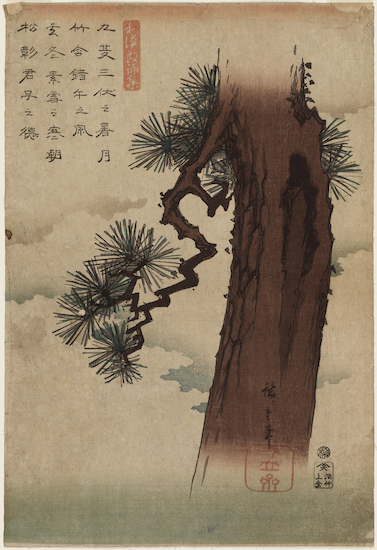 |
| Utagawa Hiroshige I (1797-1858 Japan) Pine Tree, from the series Japanese and Chinese Poems for Recitation, 1842 or 1843, color woodcut print on paper, 37.7 x 25.5 cm (14 13/16” x 10”) Image © 2025 Museum of Fine Arts, Boston (MFAB-968) |
The pine tree in Japan is a symbol for longevity, good fortune and steadfastness. When grouped with plum blossoms and bamboo they are called the Three Friends of Winter, or Three Auspicious Friends. Pine and bamboo are hardy enough to withstand winter weather as well. Traditionally, Japanese have celebrated the New Year with the kadomatsu or, "gate pine", pine boughs adorning their entrances to welcome deities, and symbolize good luck in the New Year. The waka poem in the upper left corner reads as this:
The officer of eighteenth rank thrives in frost then dew, / A thousand years of color flourishing in the snow / The poem praises the New Year pine as a metaphor for some high official for its vibrant life despite harsh winter conditions.
Waka was an intimate form of poetry that was developed among the nobility during the Heian Period (794-1185) as a way of communicating on notes rather than prose to show a person's sophistication. The majority of the waka were called tanka or "short poem". The traditional cadence of a waka poem is a rhythmic structure based on the Japanese syllable pattern of 5-7-5-7-7. This pattern consists of five lines, totaling 31 syllables
The poem in the upper left corner of this print is a kanshi written in Chinese script. Much like his bird-and-flower prints (kachō-e), Hiroshige was an expert at isolating elements of nature for dramatic (or literary) purposes. This woodcut print brilliantly imitates the contemporary painting of the Kanō School and their reduction of forms in nature to simpler shapes.
Background
The Edo (or Tokugawa) Period (1615-1868) was the last period of traditional Japan. It was a time of peace, political stability and economic growth under the military dictatorship (shogunate) founded by Tokugawa Ieyasu (1543-1616). In the 1630s there was a complete ban on Christianity, an expulsion of all foreigners except a few Dutch and Chinese traders in Nagasaki, and, from 1633, a ban on foreign travel by Japanese.
The roughly 250 years of peace led to an expansion of the Japanese economy, particularly in commerce and manufacturing, which led to the development of large urban centers, and a rise in patronage of the arts by a broad section of Japanese society. The emergence of a well-to-do merchant class brought about the development of a dynamic urban culture that found expression in a particular genre of the traditional art form of woodblock printing, the Ukiyo-e style.
Ukiyo-e means "pictures of the floating world," floating in the Buddhist sense of the transience of earthly pleasures. The earthly pleasures depicted in these woodblock prints reflected the glittering entertainment districts (yoshiwara) of Japanese cities: its theaters, restaurants, bars and shops. Eventually, however, Ukiyo-e subject matter extended into genre scenes, landscape and literary illustration.
Early Ukiyo-e images were painted, but with demand high, artists turned to the woodblock medium. Initially these prints were black and white or three color. By 1764, the multiple block process (often as many as twelve for one print, with a different color printed from each block) was perfected, creating the nishiki-e or brocade picture, so named for the wide range of colors available to an artist.
Utagawa Hiroshige was one of the most famous Ukiyo-e artists who transformed the tradition of Japanese landscape painting into woodblock prints. From childhood he showed a propensity for art, and he took lessons from an amateur painter. At fifteen he went to train with an artist of the prestigious woodblock printing Utagawa School, Toyohiro (1773-1828), a landscape painter, print designer and illustrator. While with Toyohiro, Hiroshige produced actor prints. His progress was so rapid, that he was admitted into the Utagawa fraternity within a year and given the name Utagawa Hiroshige.
Until 1830, Hiroshige produced prints mostly of kabuki actors and bijin-ga (beautiful women pictures). However, the publication of Hokusai’s Thirty-Six Views of Mount Fuji between 1826 and 1833 showed Hiroshige the possibilities of landscape. His first landscape series (late 1820s) was Famous Places in the Eastern Capital, views of popular spots in Edo (Tokyo). The series was successful, and it encouraged Hiroshige to pursue landscapes as his main subject matter.
There followed In 1832 the famous Fifty-Three Stations of the Tōkaidō scenes from the highway joining Edo (the "eastern capital") and Kyoto, the seat of the imperial court. Late in his career, in 1853, he produced further landmark series such as Famous Places in the Sixty-Odd Provinces. In 1856 One Hundred Famous Views of Edo, actually 118 prints, is Hiroshige’s brilliant documentation of late Edo period Japanese urban life executed before opening to Western powers changed Japanese society forever. He documented the city that he loved in both sweeping panoramas, and intimate genre scenes of tea houses, temples and markets.
Correlations to Davis programs: Explorations in Art 2E grade 2, 1.1; Explorations in Art 2E grade 4, 1.8; Explorations in Art 2E grade 6, 6.6; Explorations in Art 2E grade 6, 5.2; A Community Connection 2E 4.5; A Global Pursuit 2E 7.5; Experience Printmaking pp. 72-73

Comments