Gem of the Month: Ergil Vallo, Ceramic Art
A flourishing of ceramic arts is one of the historic traditions of the indigenous American cultures of the Southwest US. These cultures are collectively addressed as “Pueblo”, a reference to the traditional, often multi-story communal adobe and stone structures of those cultures. Ergil Vallo, Sr, who is half-Acoma, and half-Hopi Pueblo, has carried on this great tradition with innovative decoration that recall traditional patterns with some of his own invention. Vallo signed his works Dalawepi, which means “color of the rainbow.”
Gem of the Month: Ergil Vallo Ceramic Art
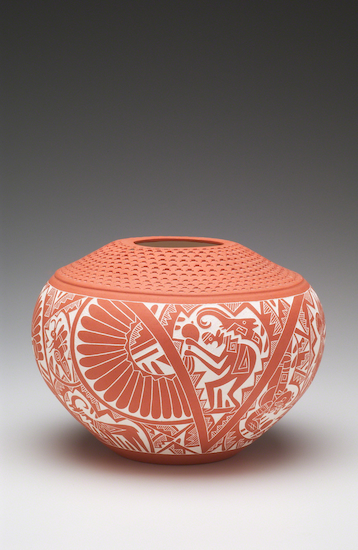 |
| Ergil Vallo (1959-2005, Acoma/Hopi Pueblo, New Mexico) Traditional Coiled Vase, 1989, slip-painted earthenware, 22.9 x 33 cm Mint Museum of Art, Charlotte, NC, © 2025 Artist or Estate of Artist (MIN-253) |
Ergil Vallo began producing ceramics when he was 21. He was influenced by watching other ceramic-artist relatives working in traditional pottery styles, and wanted to carry on the tradition of both his Acoma and Hopi heritage. This vessel is a traditional olla, or water jar, a shape seen in the ceramics of all Pueblo cultures. The shape was initially developed for Pueblo natives to carry water on their heads from wells far away from their Pueblo, often up steep inclines. Although Vallo is well-known for his black-on-black incised wares, he also produced stunning redware. Redware is one of the classical, traditional colored wares of the Hopi, while blackware ceramics are strongly associated with Acoma. This vessel contains motifs Vallo explored frequently: bees, mountain goats, and a Katsina dancer.
Background
The First Nation cultures of the Southwest developed over thousands of years and flourished between 500 and 1100 CE. There were three major cultural groups in the Southwest: the Anasazi in the Four Corners region (where the borders of Utah, Colorado, Arizona, and New Mexico meet); the Hohokam in southern Arizona; and the Mimbres Mogollon in the central and southeastern sections of Arizona and New Mexico.
Agriculture and hunting provided the means of survival for these early societies. Most modern-day Pueblo cultures are descended from the ancient Anasazi. There are hundreds of distinct Pueblo cultural groups, among them the Acoma culture.
Ceramics is the major classical art form that has survived from the early Pueblo cultures. The patterns on ceramic objects commonly symbolize elements of nature that are vital to the survival of an agriculturally based society. There are hundreds of distinct Pueblo cultural groups, among them the Acoma Pueblo. Acoma was established between 1100 and 1150, and has earned the title of the oldest continuously inhabited town in North America. Acoma means Place that Always Was, for native Acoma dwellers believe the city was built long before the Anasazi. There is evidence in the form of ceramic sherds from the earliest Acoma period of the importance of ceramic production. Acoma, also known as Sky City, is 50 miles west of Albuquerque. It is home of a really good clay which ceramic artists mix with crushed pottery sherds.
As early as 700 CE, Hopi ancestors began making pottery. From Pueblo I to Pueblo III periods (800s-1300s CE) all Pueblo cultures were making white slip painted ware with black designs. Four redware traditions also developed at that time. Like the Hopi ceramic artists of today, historic Hopi potters used the coil and scrape technique to make their wares. The pots were traditionally fired in pit kilns using sheep dung and cedar wood.
Correlations to Davis programs: Explorations in Art 2E Kindergarten unit 4.3; Explorations in Art 2E grade 3, 6.7; Explorations in Art 2E grade 4, 4.9; Explorations in Art 2E grade 6, 4.5; A Community Connection 2E 9.5; A Global Pursuit 2E 2.5, Experience Art 2.3; The Visual Experience 4E 10.10; Discovering Art History 4E 4.10; Experience Clay 3E, Chapter 2 Career Profile; Davis Collections – First Nations Art US and Ca

Comments