
February is National Embroidery Month
Like Mesoamerica, the central Andes Mountains in South America – primarily Bolivia and Peru – developed complex hierarchical societies with rich and varied artistic traditions. Unlike the development of societies elsewhere in the world, Andean cultures perfected monumental architecture and textiles before ceramics and sustained agriculture, usually the two milestones of successful early civilizations.
February is National Embroidery Month
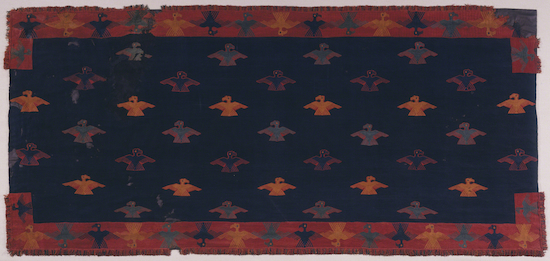 |
| Nazca Culture, Peru, Mantle, ca. 100s-600s CE, camelid wool fiber warp and weft with camelid wool embroidery, 129 x 276 cm © 2026 Brooklyn Museum (BMA-1222) |
The Nazca were skilled in all of the Andean textile techniques, including several types of weaving, embroidery, and they also painted designs on plain cotton cloth. Abstract figures were especially popular in designs and most often are depicted participating in harvest scenes which show such foodstuffs as maize and beans. Animals, similar to those in the petroglyphs and pottery designs, were also a popular subject.
This mantle, most likely for a male, bears a repeated condor motif. The camelid wool is woven in simple plain weave. The condor was much revered by Peruvian peoples. Because of its ability to fly great distances, it was considered a symbol of longevity and rebirth. The condor appears in one of the colossal line "drawings" on a plain in Peru. The reason so many sumptuous textiles such as this mantle have come down to us is because many Andean cultures wrapped the deceased in these highly prized objects when they were buried, which protected the textiles from weather and heat.
Background
Like many of the Mesoamerican and South American cultures, Peruvians evolved large city-states with religious-secular rulers. The landscape in northern south America was very different from that of Mexico. It consisted of a narrow coastal plain bordered by the Pacific Ocean in the west, and the Andes Mountains in the east. The Andes are snow-capped peaks surrounding high grasslands and deep, fertile river valleys. The eastern side of the Andes descend into the lush basin of the Amazon River.
Andean people, in contrast to Mesoamerican peoples, developed monumental architecture and ceramic arts before textiles and agriculture. The earliest period of monumental building was ca. 3000 BCE with mound-like ceremonial centers built near the coast. The inland cultures built stone-walled cities with sunken, circular religious areas. Agriculture gradually became important to both societies.
The Nazca are thought to have arisen out of the Paracas culture which flourished ca. 750 BCE to 100 CE. The Nazca culture was characterized by a collection of independent chiefdoms. Although there are cultural and artistic similarities among these communities, they did not -- like other Meso- and South American cultures -- build great cities of standardized design.
As the Nazca expanded their influence, they traded with inland mountain regions where alpaca and llama was raised for their fur, and rain forest regions where they secured the feathers of tropical birds for garments. The best source for Nazca art objects is from their tombs, which were often 4 to 5 meters (13 to 16 feet) deep.
The Nazca culture produced sophisticated ceramic art, gold and metal objects, and particularly sophisticated textiles. The textiles of ancient Peru, woven in every known technique for over three thousand years, represent the highest achievement of their civilization. Textiles were the most highly prized objects after gold in Peruvian cultures.

Comments