February 6, 2026 is National Wear Red Day: Art by Bronzino (1503-1572 Italy)
National Wear Red Day was established in 2004 by the American Heart Association as part of their “Go Red for Women “ campaign. The campaign was aimed at calling attention to the under-diagnosis of heart disease in women, which is a major factor in women’s health. The day is always promoted on the first Friday of February.
February 6, 2026 is National Wear Red Day: Art by Bronzino (1503-1572 Italy)
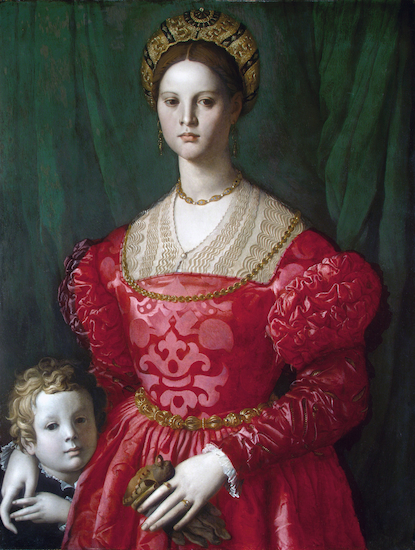 |
| Bronzino (Agnolo di Cosimo Mariano), A Young Woman and Her Little Boy, ca. 1540, oil on wood panel, 99.5 x 76 cm © 2026 National Gallery of Art, Washington (NGA-P0107) |
A Young Woman with her Little Boy displays Bronzino's marble-hard, reserved and elegant portrait style that typified his court portraits. The long-necked, slope-shoulder female form is pure Pontormo, while the hard, almost contour-defined edges of the forms are a holdover from Raffaelino.
The standard Renaissance pyramidal composition was made asymmetrical by the later addition of the boy. Asymmetry was a standard compositional device of Mannerism. The emphasis on cold elegance and refinement, also part and parcel of Mannerism, takes precedence over an actual likeness of the sitter. The artist was more interested in the details of her costume than humanizing the doll-like face.
Background
Although the period in art called High Renaissance is arbitrarily cut off after the death of Raphael (1520), the high point of Renaissance art during that period did represent a brief peak in the humanistic, scientific and mathematical ideals applied to art that had first been explored in the 1400s. The idealized, serene, balanced, and overtly classically-oriented style was restrictive and virtually codified by the first ten years of the 1500s.
By the second decade of the 1500s, there were many artists who altered or openly defied the principles upon which the High Renaissance were based. The style is sometimes called Mannerism, in the sense of a mannered style, meaning certain artificiality, refinement and sophistication based in Renaissance technical excellence.
The reaction to the High Renaissance (Mannerism) is generally accepted to have evovled in Florence. Michelangelo's sculpture of the Medici tombs in the Medici Chapel of San Lorenzo (1520-1534) had a major impact on Mannerism. The figures on the Medici tombs were elongated, in twisting poses, set uncomfortably large on a cramped classical architetural stage. Rosso Fiorentino (1494-1540) , along with Jacopo da Pontormo (1494-1557) are the two artists who helped bring the Mannerist style to maturity in its early period in Florence.
Bronzino was born in Monticello, outside of Florence, the son of a butcher. His earliest art education came in Florence at the age of 11 under the Renaissance master Raffaelino del Garbo (1466-1524). Raffaelino painted much in the style of the early Renaissance master Filippo Lippi (1406-1469) whose style was classically Florentine in its reliance on classical iconography and hard-edge contour-lined forms. Bronzino may have been dissatisfied with the traditional training he received under the master, for a year later he joined the workshop of the pioneer of Mannerism, Pontormo.
Bronzino quickly and expertly absorbed the Mannerist style of Pontormo during the 1520s. He is known to have helped the master paint many works in the 1520s, so little is known of his individual style. This he debuted in 1530 after fleeing the Seige of Florence (1529-1530) by French and Holy Roman forces and landing in Pesaro. He was invited by the Duke of Pesaro and Urbino (Guidobaldo II della Rovere, 1514-1574) to paint a cupid in the Villa Imperiale, and the duke was so pleased with the outcome that he commissioned Bronzino to paint his portrait.
Bronzino's ducal portrait was well received and Bronzino's fame spread when he returned to Florence after the restoration of the Medici to power. The Holy Roman Empire victory over Florence made it a duchy of the empire. Bronzino now gained fame in Florence for his portraits of the nobility and members of the Medici family after he was made court painter in 1539. By this time he had formed his mature style, one that would influence portraiture in Europe for another century.
Correlation to Davis programs: Exploring Painting 3E, Chapter 10, The Human Figure; Discovering Art History 4E, Chapter 9 The Italian Renaissance, 9.3 – Mannerism

Comments