December is National Pear Month
In 2004, the U.S. Department of Agriculture declared December as “National Pear Month.” I did not realize that pears have as much potassium as bananas. And they are certainly interesting as subjects in still-life paintings. I am a huge fan of northern Baroque (1600-1750) still life painting. Many women became professional artists during the 1600s, some of them renowned throughout Europe. Giovanna Garzoni (1600-1670 Italy) probably followed the typical path to being a professional artist as a woman, producing botanical and still life works starting at the age of 16. This beautiful little piece features pears prominently.
December is National Pear Month: Art by Giovanna Garzoni (1600-1670 Italy)
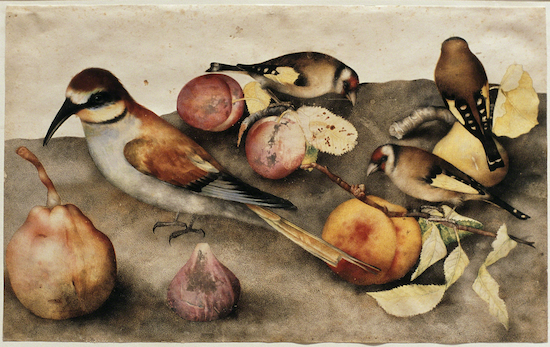 |
| Giovanna Garzoni, Still Life with Birds and Fruit, after 1630, watercolor on parchment, 25.7 x 41.6 cm Cleveland Museum of Art, Image © 2025 Ron Wiedenhoeft / Saskia, Ltd. (MIF-2152) |
Garzoni achieved fame with her naturalistic still lifes on vellum, which combined scientific accuracy with sensitive artistry. Here, three small goldfinches on fruit branches and a larger bee-eater are dispersed across an earth-toned ground. The goldfinches sit on branches from which hang two plums (left), and a peach (center),with a pear on the right with a bird perched upon it. A yellow quince and purple fig appear in the left foreground. Garzoni’s refined interpretations of the natural world suited the taste of aristocratic patrons like the Medici family, who acquired her drawings to decorate their villas.
Background
Plants, animals, and insects have been standard decorative motifs in many types of art throughout history. The earliest serious studies of plants came from the ancient Mesopotamians and Egyptians, and it was the Greek philosopher Theophrastus (ca. 370–285 BCE) who initiated a series of studies of the medicinal qualities of plants. In naïve first century BCE, Greek physician Crateuas is widely considered the first person to compile botanical illustrations.
Out of these compilations of images of medicinal plants the study of all plants and flowers evolved. Until the Renaissance (ca. 1400–1600) in Western Europe, these illustrations, often rendered by scientists, were crude or naïve. With the Renaissance’s emphasis on the physical world in art and realism, compilations of plant imagery became more sophisticated — and popular — particularly after the development of the printing press, enabling printed books, or florilegia, of these compilations to be made.
By the 1600s and 1700s, botanical art was a respected field, as was still life, although it was not considered to be fine art. It was during this period, however, that many traditionally trained artists –turned to precisely detailed paintings of plants, animals, and insects — a genre that was particularly popular in Northern Europe. Because women were excluded from academic training in the West until the late 1800s, many of them specialized in bird and flower paintings and still life because the subject did not require human anatomy lessons or extensive space, and the subject could be set up in the home.
Giovanna Garzoni was one of the earliest women artists to specialize as a still life painter. Born in Ascoli Piceno around 1600, little is known about her upbringing or training. She likely studied with her painter uncle Pietro Gaia (dates unknown) around 1615/1616. Her first commission was for the depiction of a collection of dried herbs for a pharmacist in Venice in 1616. She first visited the Medici court in Florence between 1618 and 1620 where she met fellow artist Artemesia Gentileschi (1593-1653). She became known for her paintings of religious, mythological and allegorical subjects early in her career. This changed after she studied calligraphy with calligrapher Giacomo Rogni (dates unknown), after which (ca. 1621) she produced a book of letters illustrated with birds, flowers and insects. This was the earliest example of what would become subjects for which she was best known.
Between 1630 and 1642 Garzoni fulfilled commissions in Naples, Rome, Turin, and Paris. In 1635 she made the earliest known European miniature of an African sitter. She settled in Rome in 1642, and between that year an 1651 she spent much time also in Florence producing art for the Medici family. She made botanical illustrations, still life, and portraits, working in various media.
Correlations to Davis programs: Explorations in Art 2E grade 2, 3.1, 3.2; Explorations in Art 2E grade 3, 5.2, 5.3; Explorations in Art 2E grade 4, 4.1, 6.8; Explorations in Art 2E grade 5, 2.1, 2.2, 2.3, 4.4; Explorations in Art 2E grade 6, 1.8, 2.8; A Global Pursuit 2E 5.3; A Personal Journey 2E 5.3; Experience Art 2.2; The Visual Experience 4E 4.9

Comments