Celebrating African American History Month 2026: Anna Williams
The history of African American artists goes back to the earliest days of the US. There are numerous art forms that can trace their lineage back to the African ancestors of African Americans, who carried knowledge of those art forms with them when they arrived in the US. One of the more significant art forms that African Americans specialized in once they were in America was fiber arts of all types, including quilting. The quilts of Anna Williams (1927-2010) reflect this unique aspect in African American art history that demonstrates the incredible importance African American artists play in American culture.
Celebrating African American History Month 2026: Anna Williams
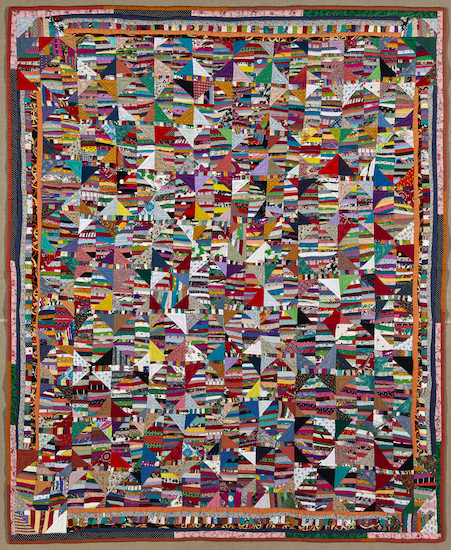 |
| Anna Williams, Album Quilt, 1995, cotton and synthetic fabrics, 193.7 x 156.2 cm (76 1/4" x 61 1/2”) Courtesy of Brooklyn Museum, © 2026 Artist or Estate of Artist (BMA-5181) |
Quilts became a naturally important art form for African Americans during the 1800s, saving every piece of unused material that was used for making clothes. During slavery times, African Americans combined their knowledge of African fiber arts with the quilting tradition. Album quilts are traditionally sewn by a group of women who each add a unique block to the quilt. The album quilt became popular in the mid-1800s. Introduced in the US in the 1840s, sewing machines became widely used for quilting after the Civil War (1860-1865), often in combination with handwork techniques. Extensive experimentation throughout Williams' career has resulted in complex versions of this traditional technique.
Anna Williams was born on Kleinpeter Plantation near Baton Rouge, LA. She first witnessed quilting with her mother and grandmother. Gathering up colorful scraps of cloth they dropped on the floor, she converted them into clothing for her doll, and then a baby quilt at age 9. All of her quilts were piece work. She never used a template for cutting, but played with scraps and strips as she did when a child until it was pleasing to the eye.
Background
Until the 1900s, folk arts -- the miscellaneous arts of textiles, woodwork, metalwork and ceramics -- were denigrated as unsophisticated because they were considered the work of untrained rural people. This included the work of itinerant painters and sculptors who did not seek professional training in their chosen art forms. Folk art ascended in appreciation in the first quarter of the 1900s when modernism showed the same characteristics of a bold, instinctive sense of design and color that seemed effortless for folk artists and conscious effort for modernists.
This was especially true about fiber arts, specifically quilts. Once considered haphazard arrangements of scraps of cloth, in the 1900s, quilts gained recognition as works of art when the range of aesthetic expression is examined. They can display dazzling, abstract effects anticipatory of Op Art, or the most detailed realism of embroidery. The two main types of quilt are appliqué -- in which shapes are cut out of whole cloth and sewn onto a background fabric -- and pieced -- in which pieces are sewn together side by side.
Quilting, in the West, evolved out of the medieval (ca. 1000-1400) practice of producing quilted cotton or linen garments for men to wear under their armor. This practice was soon transferred to the production of throws to adorn beds. In more affluent homes, these quilted cotton throws were decorated with embroidery or appliqué. In the US, quilted bedspreads became common during the colonial period when the British forbade tailors from leaving for the US. Pieced bedspreads made from worn out fabrics became common among the less-than-affluent. Quilting was one of the most important art forms among African Americans during the pre-Civil War (1861-1865) period. Black artists applied technical knowledge of African fiber arts traditions into quilting, with patterns and techniques that endure into the 21st century.
Correlations to Davis programs: Explorations in Art 2E grade 1, lesson 5.6; Explorations in Art 2E grade 4, lesson 5.1; Explorations in Art 2E grade 5, lesson 2.4; A Global Pursuit 2E, lesson 6.6

Comments