
Bringing Women's History Month to a Close
There are many of what I consider “art heroes” among artists, and if anyone deserves such a title, it would be the late Miriam Schapiro (1923-2015, US, born Canada). She was a key player in the early 1980s in establishing more visibility for women artists, not only establishing the Women’s Caucus for Art and the Women’s Art Program at the California Institute of Arts, she was also a leading member of the vibrant Pattern and Decoration movement. This movement, pioneered by women artists, included many male members.
Bringing Women’s History Month to a Close
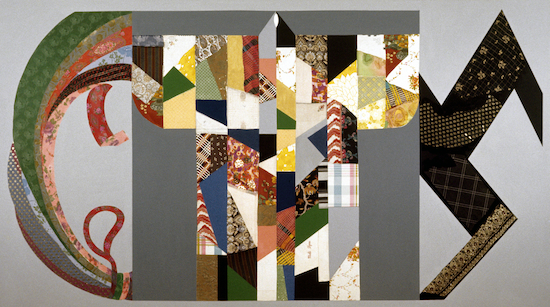 |
| Miriam Schapiro, Anatomy of a Kimono, 1976, watercolor and fabric collage, 203 x 363 cm (80” x 142 15/16”) Photo Courtesy of the late Artist, © 2026 Estate of Miriam Schapiro / Artists Rights Society (ARS), New York (8s-18308sroars) |
In 1974, Schapiro helped form the Pattern and Decoration group of New York artists. In Schapiro's personal work, the elevation of pattern and decorative arts -- formerly considered an "appropriate" domain for women artists -- became the primary focus. Schapiro made several versions of the iconic Anatomy of a Kimono. The artist based the composition on designs from Japanese fans, kimonos and fabrics. She collected donated handkerchiefs and pieced them together with other bits of fabric in shapes that vaguely mimic the shapes in a kimono. The large scale of the work rivals the size of Abstract Expressionist works, while the materials and patterns reinforce Schapiro's elevation of "women's work" to high art.
Background
By the mid- to late-1960s, the Martin Luther King assassination, Civil Rights movement, and demonstrations against the Vietnam War caused the establishment of a large counterculture in the US. This young counterculture challenged the values and policies of the male-dominated, materialistic Western society. Art movements of the late 1960s began to reflect the collapse of the mainstream of American art, dominated by the market-driven, commercially oriented Abstract Expressionists.
The 1970s marked the beginning of the Women's Art Movement. The questioning of the status quo in American society led women in increasing numbers to express their outrage against gender bias. Several books, including The Feminine Mystique (1963), helped raise women’s awareness. Women artists, art historians and critics began to organize and speak out against the bias against women artists. They formed cooperative galleries, university women's art programs and coalitions that published art journals and reviews of women’s art. These efforts were complimented by a widespread public desire to see more open, pluralistic and humanistic art.
In 1972, the Women’s Caucus for Art was formed by a group of women artists that included Miriam Schapiro. The group gave women a forum to explore issues surrounding women artists and art history. The 1976 Los Angeles County Museum Show “Women Artists: 1550-1950” gave major impetus to the Women's Art Movement. It brought to light for women artists the accomplishment of artists from past centuries and gave them a reference point for their place in history.
This newfound awareness of self gave many women the confidence to work in radical styles and subject matter previously considered “improper” for women. For the first time in history, many women were producing issue-based art concerning the repression and lives of women. The proliferation of styles helped educate the art world and give it a broader frame of reference for art criticism and acceptance.
Schapiro, born in Toronto, Canada, received weekly art lessons from her father beginning at the age of six. She studied at the Museum of Modern Art at 14, and attended Federal Art Project classes. Studying printmaking, she attained BA and MFA from the University of Iowa (1945, 1946, 1949). When she moved to New York in 1951, her developed style was Cubist-influenced. That soon changed under the influence of Abstract Expressionism's dominance during the 1950s, when she adopted an similar painterly style.
Starting in 1960, Schapiro gradually discarded the Abstract Expressionist painterly mode for variations on a so-called "Shrine" series that featured framed compartments containing feminine symbols, often self-referential to gender. This series (1963-1965) would have major stylistic impact on much of her mature work.
Between 1967 and 1970, she began to experiment with computer-aided design to Hard Edge type paintings. In 1971, along with Judy Chicago (born 1939) who shared her sensibility, she founded The Women's Art Program at the California Institute of the Arts, Valencia. Involved in teaching, Schapiro temporarily gave up painting.
Correlations to Davis programs: Explorations in Art 2E grade 2, lesson 4.7; Explorations in Art 2E grade 4, lesson 2.6; Explorations in Art 2E grade 5, lessons 3.1 and 3.7; Explorations in Art 2E grade 6, lessons 1.5 and 1.6; A Community Connection 2E lesson 8.1; A Global Pursuit 2E lessons 8.6 and 9.3 The Visual Experience 4E, lesson 8.5; Experience Art, lessons 3.1 and 3.3; Davis Collections -- Women Artists 1900s; Davis Collections --Fiber as Art

Comments