Beauty Attack = Gorgeous Gauguin
If you are as taken with the color of the most prominently written about Paul Gauguin (1848-1903) paintings, then you will simply drool over this early still life. The background colors are particularly striking, so this painting gets my “Beauty Attack” stamp of approval.
Blog for 6 January, 2026: Beauty Attack = Gorgeous Gauguin
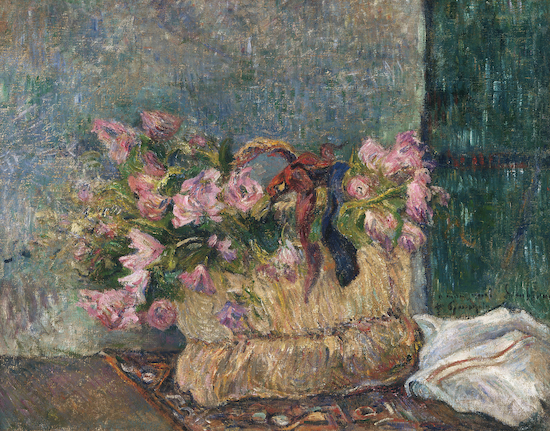 |
| Paul Gauguin, Still Life with Moss Roses in a Basket, 1886, oil on canvas, 50 x 63.2 cm (19 11/16” x 24 7/8”) Image © 2026 Philadelphia Museum of Art (PMA-2874) |
This early still life pre-dates Gauguin's trip to Panama. It reflects both the palette, and brush strokes of Pissarro. Gauguin's still life works before his period in Brittany (1885-1888) tended to be more traditional in subject matter, but definitely under the influence of the brush work of Paul Signac (1863-1935) and Georges Seurat (1859-1891), and the palette of Impressionism. He felt that this type of regurgitation of what the artists saw in front of him made for a flat, lifeless painting. Ultimately, he eschewed copying from nature and he threw out what he considered the "limited" palette of Impression to explore more subjective and vibrant color.
Background
Like most major art movements grounded in strict theories, Impressionism ran its course as a ground-breaking art movement between the 1870s and the 1880s. By that time, some artists rejected the limited theory of Impressionism which neglected psychological depth and emotional involvement in the work of art. Light and color were still major concerns of the Post-Impressionists, but they rejected the momentary, detached mood of Impressionism which emphasized the technical aspect of the work of art rather than the subject.
Post-Impressionism was transitional to the highly subjective strains of art of the 1900s. The Post-Impressionists reinvested the subject matter with importance, by using it as the focal point of studies in what the very nature of subject and composition should be. Paul Gauguin's painting freed color from imitating observed nature and distorted form for purely visually expressive purposes.
Gauguin was born of a Peruvian mother and French father in Paris, and spent his early childhood in Lima. An upbringing with his mother's native nobility family instilled a need in him for restless voyage in seeking exotic destinations. A brief stint as a merchant seaman fulfilled this need and he visited such distant parts of the world as India and the Black Sea.
Between 1870 and 1886 he enjoyed a comfortable life as a stock broker, a job arranged by his guardian. His guardian introduced him to the Impressionist Camille Pissarro (1830-1903) and by 1879 became an unofficial pupil. Through Pissarro his painting attracted the attention of the Impressionists, with whom he exhibited in 1879 and 1882.
In 1883 he lost his stock broker job and decided to concentrate on painting. He was soon bored with Impressionism. He felt that painting should be something independent of nature, a synthesis of the artist's remembered experiences rather than perceptual experiences, which were the backbone of Impressionism. He used color, color harmonies and lines as forms of abstract expression.
In his search for the ultimate expression of his theories, he was influenced by Asian, Mesoamerican, and other non-western art. In order to escape the artistic influences of western tradition (and establish himself as the premier avant-garde artists in Europe), and in an effort to live a simpler life, he visited Panama and Martinique (1886), and moved to Tahiti (1891-1893 and 1895-1901) and ultimately the Marquesas Islands (1901-1903).
In 1885 and 1888, Gauguin went to Pont-Aven in Brittany, a rugged, isolated corner of northwest France, where Gauguin sought an unspoiled, more "primitive" life. He was charmed by the landscape, the conservative Christian culture, and the people dressed in local traditional costumes. In Pont-Aven he encountered the Synthetist painter Émile Bernard (1868-1941), whose work had a profound impact on Gauguin's. Synthetism was a strain of Post-Impressionism that embodied the brilliant color of Impressionism with the personal expression and vision that Gauguin so sought after.
Before the late 1880s, Gauguin’s painting style was dominated by the Impressionist palette and the rapid, short brush work of artists such as Georges Seurat (1859–1891) and Paul Signac (1863–1935). After he became dissatisfied with Impressionism, he began to affirm that an artist should not paint too much after nature, but rather infuse the work with remembered imagery. Like Vincent van Gogh (1853–1890), he abstracted nature into flat forms balanced with color harmonies. He termed his simplification of forms and color Synthetism.
Correlations to Davis programs: Explorations in Art 2E grade 1, 1.5; Explorations in Art 2E grade 2, 5.4; Explorations in Art 2E grade 4, 6.8, 6.9; Explorations in Art 2E grade 5, 2.1, 2.2, 2.3; Explorations in Art 2E grade 6, 1.8; A Global Pursuit 2E 5.2, 5.3; A Personal Journey 2E 2.6; Experience Art 2.2; The Visual Experience 4E 4.9; Exploring Painting 3E chapter 9; Discovering Drawing 3E chapter 3; Exploring Visual Design p. 71 studio

Comments