Artist's Birthday: Gabriele Münter (1877-1962 Germany)
Like the American modernist movement Abstract Expressionism, German Expressionism was dominated by male artists with strong personalities. But there were many significant women Expressionists in Germany at the time, which included Gabriele Münter.
Artist birthday Beauty Attack for 19 February: Gabriele Münter (1877-1962 Germany)
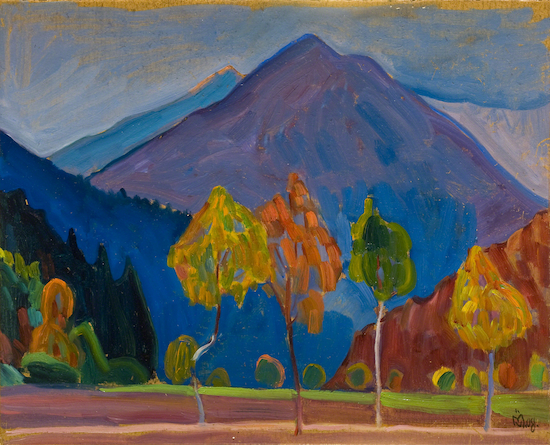 |
| Gabriele Münter, Mountains in the Twilight, 1908, oil on paperboard, 32.8 x 40.6 cm Hirshhorn Museum and Sculpture Garden, Smithsonian Institution, Washington, DC, © 2026 Artists Rights Society (ARS), New York (SI-248mbars) |
This painting represents an evolution in Münter's practice, as she composed this landscape by foregrounding color studies, rather than relying on the highly textured or naturalistically-contoured renderings of her earlier works. She depicted the Alps in vibrant blue tonalities, intermixed with shades of a light, reddish purple, which, in turn, incorporate lighter colors of lavender and yellow as the mountain range recedes to align with the distant blue and yellow sky. This interest in depicting the landscape as an interplay of color constituted Münter's early experiments with what would become the definitive Blaue Reiter aesthetic.
Background
Expressionism in northern European art of the early 1900s was an offshoot of art movements in the 1800s that emphasized romanticism, expressive color, or symbolic (rather than representational) subject matter. The objective in expressionist work was to express the artist’s feelings about the subject and to elicit an emotional reaction from the viewer.
German Expressionists built on the aims of Post-Impressionist artists who rejected the Impressionist emphasis on optical accuracy and turned towards the world of the spirit. They employed a variety of styles to give visible form to their feelings, often relying on direct, sometimes crude expressions. Their art was basically an expression of inner meaning through outer form.
Gabriele Münter first studied painting when she was twenty at a school in Düsseldorf for young women, since women were not allowed in German state academies. She was dissatisfied with traditional, academic painting and in 1901 enrolled in the Russian expressionist painter Vasily Kandinsky’s (1866-1944) Phalanx School in Berlin. In that school men and women were taught side by side. She and Kandinsky became close friends and they traveled Europe together between 1903 and 1908, a trip that included a two-year stay in France. In France they saw the work of the Fauves, the bright, jarring colors of which greatly influenced them.
On returning to Germany, she, Kandinsky and other artists settled in the Bavarian town of Murnau. The group of artists painted in similar, expressionist styles and encouraged each other. Unlike other expressionists in Germany who stressed pathos and the dark side of life, Münter and the other Murnau painters produced more lyrical works. Like other expressionists, they stressed the need for artists to express inner vision, but used jarring color, expressive line and form to relay content, rather than subject matter. Along with Kandinsky and Franz Marc (1880-1916) Münter formed the group Der Blaue Reiter ("The Blue Rider"), which was meant to promote expressionist painting of a more lyrical nature.

Comments