Artist Birthday: Wolfgang Laib (born 1950 Germany)
Inspired by the teachings of the ancient Taoist philosopher Laozi, Wolfgang Laib creates sculptures that seem to connect that past and present, the ephemeral and the eternal. Working with perishable organic materials as well as durable ones that include granite, marble, and brass, he grounds his work by his choice of forms—squares, ziggurats, and ships, among others.
Artist Birthday for 25 March: Wolfgang Laib (born 1950 Germany)
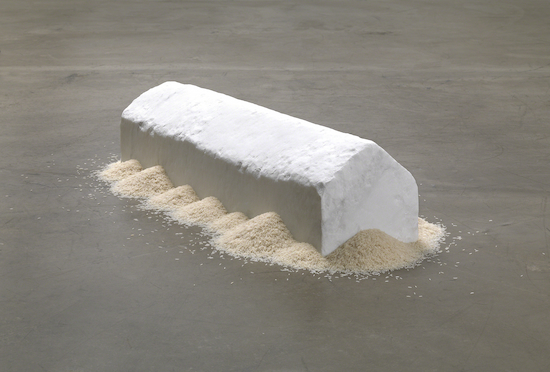 |
| Wolfgang Laib, Rice House, 1988, marble, rice and hazelnut pollen, 21.6 x 89.2 x 22.9 cm The Museum of Modern Art, New York, © 2026 Wolfgang Laib (MOMA-S1363) |
Laib has created several versions of Rice House. Rice is a frequent material used in his work, the ongoing exploration of physical and spiritual well-being emphasized in the quiet sense of meditation his works evoke. Having traveled extensively to Turkey, Iran, Afghanistan and India during the 1960s, Laib developed a deep appreciation for Buddhism and its emphasis on connection with nature in the search for enlightenment. Laib has explained that the gathering ("harvesting") of materials he uses -- such as rice, pollen and bees wax -- is more important than the resulting work. While works such as Rice House may seem to convey a Minimalist aesthetic, there is a rich spiritual narrative to such works which the artist encourages the viewer to contemplate.
Background
Many art movements of the 1900s, rebelling against one traditional dogma or another, chose a sort of ironic distance -- either stylistically or philosophically from the finished work of art. Examples of such movements would include Surrealism, Pop Art, Photorealism, Minimalism and Conceptualism. Late in 1900s, many artists began to avoid such distance so that the viewers of their work encountered a significant aesthetic experience with the work itself. This intention was most powerful in installation art.
Installations of the 1960s and 1970s, often involving performance, engaged the participant in the experience of an ideological aesthetic experience, or caused them to reflect on specific ideological or philosophical agendas. Installations of the 21st century continued these concerns, while many others were imbued with personal reflection or memory by the artist. The subject might be of the artist's life experience, or an innately personal aesthetic experience that the artist wants to share to the viewer.
Wolfgang Laib is a conceptual artist who creates installations in which he wishes to recreate his own personal sensations experienced from the simplest elements of everyday life. He was born in 1950 in Metzingen. He studied medicine (1968-1974), before he discovered Zen Buddhist and Taoist philosophies, after which he abandoned medicine for art.
Laib's work -- using the simplest of materials such as rice, beeswax, or pollen -- are intended to engender in viewers the same feelings of awareness of the completeness of creation that he has come to learn from his own experiences with his family.
Laib's personal spirituality is encapsulated in his installations and sculpture that he has pursued since 1975. He uses the simplest of materials from nature in order to address the ephemeral rather than the concrete in the degradable, impermanent materials that he combines with enduring supports such as marble or wood. The viewer is encouraged to reflect inwardly on the beauty of the natural materials that humans could not create. This impact is heightened by his reliance on a Minimalist aesthetic in construction.
Correlation to Davis program: Explorations in Art 1E, grade 4, lesson 6.32

Comments