Artist Birthday: William Wegman
While starting out with black and white photography of banal everyday actions, William Wegman is most likely best known for his endearing work with a series of dogs. His photographs of these dogs usually document some silly situation or setting, but invariably are loveable.
Artist Birthday for 2 December: William Wegman ( born 1943 US)
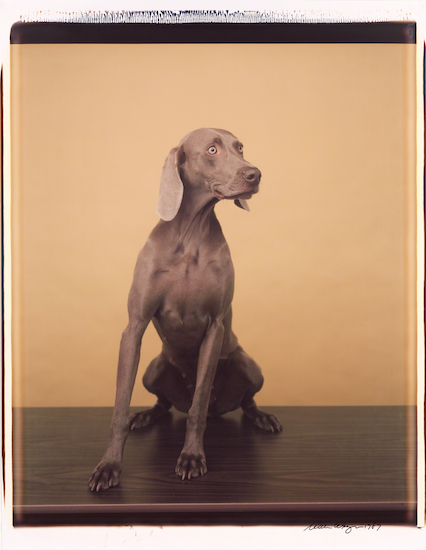 |
| William Wegman, Fay / Ruscha, 1987, one two-color instant print of a diptych, 61.6 x 51.4 cm The Museum of Modern Art, New York, © 2025 William Wegman (MOMA-P4029) |
The Weimaraner dogs used in Wegman's photographs and videos became the artist's most valuable "found objects" in his work. After Man Ray died in 1982, Wegman did not get another Weimaraner until 1986, whom he named Fay Ray -- a parody name of the 1930s movie actress Fay Wray (1907-2004) best known as the screaming woman in King Kong (1933) movie. He did not start photographing Fay until 1987, which is when he began extensive use of the Polaroid 24"x20" (61 x 51cm) camera. That camera produced a huge 61 x 51 cm instant photographic print which was archival, and renowned for the sharpness of detail and rich color. Fay / Ruscha ( only half of the diptych) is a sly dig at Wegman's colleague, Pop artist Edward Ruscha (born 1937). He is visually comparing the typical sagging mouth line of the Weimaraner with the perpetual sour look on Ruscha's face.
Background
Just as many modernist artists were defining their process in the 1960s – such as geometric abstraction, Color Field painting, and Minimalism – other progressive artists came to believe that form was not always necessary for expressing aesthetic vision, or expressive content. The art movement that actively disputed the relevance of art objects as opposed to the ideas behind them was called Conceptualism. Conceptualism holds that the idea is the work of art. These artists believe that any painting, sculpture, photograph or video is simply part of the documentation/record of aesthetic expression as opposed to the finished object of that expression. The Dada movement and Marcel Duchamp’s (1887-1968) “readymades” (found object pieces) were the most influential source for the Conceptualist idea.
The photographs and videos of Conceptualist/Postmodernist artist William Wegman are the photographic version of Duchamp’s readymades, documenting banal, everyday occurrences as complex ideas. Born in Holyoke, Mass., Wegman received a BFA in painting (1965) from the Mass. College of Art, Boston, and an MFA (1967) from the University of Illinois Champagne-Urbana. Wegman’s earliest works were Minimal sculpture, first exhibited in 1969 in New Jersey.
After moving to California in 1970, he turned to Conceptualist photo-documentation. His earliest photograph series depict his Minimal sculptures “responding” both to his studio environment and then each other. He soon added himself in these photographic series, analyzing often seemingly impossible situations. These photographic series included parts of his body in close-up, depicting trompe-l’oeil illusions and subtle changes from one photo to another. His groups of photographs were self-contained, building an illusory world, and often dealing with perceptual illusions. Wegman infused these self-explorations with lighthearted humor and potent irony.
In 1971 Wegman got a Weimaraner dog whom he named Man Ray. This began a long and fruitful collaboration where Man Ray and subsequent dogs Wegman acquired were posed in various costumes and situations that were both banal, and often a total escape from reality. Around the same period he began exploring videos, which were typified with short, staged vignettes using everyday items or situations in which expectations are reversed, and where puns are pursued to absurd conclusions.

Comments