
Artist Birthday: William Henry Fox Talbot (1800-1877 Britain)
In the history of the development of the art form of photography, few individuals have contributed more innovative ideas than William Henry Fox Talbot. He perfect many of the optical and chemical aspects of photography that would impact further developments in the genre well into the 1900s.
Artist Birthday for 11 February: William Henry Fox Talbot (1800-1877 Britain)
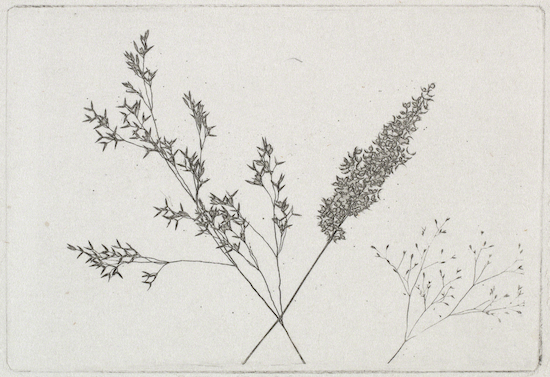 |
| William Henry Fox Talbot, Wheat, ca. 1854, photoglyphic engraving on paper, 6.8 x 20.1 cm Image © 2026 The Museum of Modern Art, New York (MOMA-P2301) |
In 1851 Talbot discovered a way of taking instantaneous photographs, and his “photoglyphic engraving” (patented in 1852 and 1858), a method of using printable steel plates and muslin screens to achieve quality middle tones of photographs on printing plates, was the precursor to the development in the 1880s of the more successful halftone plates. The image transferred to the metal plate recorded more halftones than Talbot's calotype process. Because Talbot believed that photography's main strength was in documenting subjects, he worked quite a bit with agricultural and floral specimens early in his experiments with photography. He considered a compendium of plants to be a necessary resource for scientists.
Background
Experiments with chemicals in the 1600s and 1700s would lead to photography. Silver nitrate, silver chloride and ferrous salts were identified as chemicals that reacted to sunlight and heat. Silver nitrate was discovered to darken when exposed to sunlight. Experiments in the light sensitivity of silver chloride and chemical salts also revealed that these chemicals required various amounts of exposure time to light to attain degrees of darkness.
In the late 1700s, English chemists tried transferring painted images on glass onto leather and paper moistened with a solution of silver nitrate. Although these early experiments failed to halt the action of light on the silver salts, they did demonstrate that it was possible to chemically transfer pictures and objects by means of light.
Nicephore Niepce (died 1833, France) was the first to successfully transfer an image onto a metallic surface came, in 1827. He went from using a bitumen-coated pewter plate to silver and silver-coated copper surfaces. He also added iodine to increase the sensitivity of the silver surface. However, this process required eight hours of exposure time for a single image. Louis Daguerre (1787-1851, France) continued refining Niepce’s process. By 1835 he had had reduced the exposure time necessary by the process of chemical development of the image on the metal plate.
William Henry Fox Talbot (1800-1877, England) developed the first permanent images on paper coated with alternate washes of sodium chloride and silver nitrate. The spatial and tonal reversals (negative) were corrected by placing another coated piece of paper against the negative and exposing both to light. This first negative/positive process was patented in 1844.
Talbot was from a wealthy family and was university trained. His interests lay more in astronomy, mathematics and optics rather than chemistry. While sketching in Italy in 1833, he first conceived of the idea of making permanent the image seen in the camera obscura. He began experimenting with the process on his return to England.
Talbot regarded photography as important primarily because it could supply a visual record of facts. Although not interested in the commercial uses of photography, he was keenly interested in its aesthetic uses. Talbot promoted the use of photographs in book and magazine illustration. Talbot’s Pencil of Nature, published in serial between 1844 and 1846 and filled with his own photographs, was the first book published that explored the scientific and practical applications of photography. This publication made Talbot the first person in history to publish a book illustrated with photographs.

Comments