Artist Birthday: Tim Hetherington
Tim Hetherington was a bold photojournalist who documented the war in Afghanistan between 2007 and 2008 in the Koragal Valley, where 70 per cent of American bombs were falling when he covered that region. The casualty rate for Allied soldiers was 25 percent. His unique Sleeping Soldiers video installation revealed just how young many of the American and allied soldiers were.
Artist Birthday for 5 December: Tim Hetherington (1970-2011 Britain)
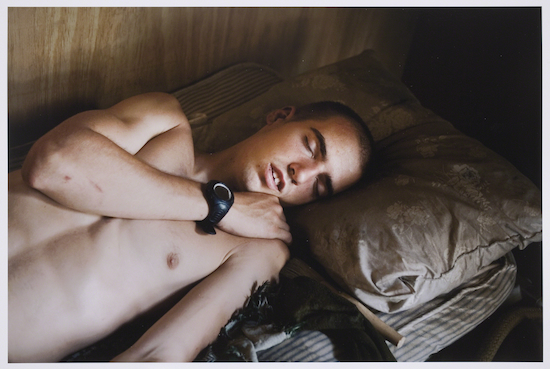 |
| Tim Hetherington, Sleeping Soldier (Specialist Michael Cunningham), Korangal Valley, Kunar Province, Afghanistan, 2008, dye coupler print, 22 x 33 cm Worcester Art Museum, Worcester, MA, © 2025 Artist or Estate of Artist (WAM-805) |
In 2007, Tim Hetherington accepted an assignment from Vanity Fair magazine to document the American campaign in the Korangal Valley in Afghanistan with writer Sebastian Junger (born 1962). The assignment became immersive as Hetherington shared every aspect of the battalion’s experience including injury and a two-day march on a broken ankle. Hetherington considered himself as simply an “image-maker” for this assignment rather than a photojournalist or documentary filmmaker.
Hetherington photographed a series of American soldiers while they slept, capturing these moments of peace and innocence that stood in stark contrast to the violence and bravado of battle scenes. The emotional impact of these quiet portraits far outweigh scenes of actual conflict. These photographs became part of a 2009 installation in New York called Sleeping Soldiers, in which the images fade in and out overlaid by ambient sounds of battle and other horrors these soldiers experienced while they were awake.
Background
After photography was invented in 1839, several wars broke out that gave photographers a chance to experiment with the new medium and the latest photographic technology in the field. The Second Sikh War (1849–1850), Second Burmese War (1852) and Indian Mutiny (1857–1858) all provided photographers with opportunities to capture war in action. The Crimean War (1853–1856) was the catalyst for the first large body of photographic images that became known as “war photojournalism.” In the United States, daguerreotypes documented the Mexican War (1846–1848), but the Civil War (1860–1865) prompted the most extensive and grisly documentation of war’s brutality by far.
The horrors of World War II (1939–1945) and the Korean War (1950–1953) were graphically documented, and the Vietnam War (1955–1975) was extensively covered by photojournalists, becoming the first “television war,” with images transmitted nightly on television news broadcasts in the United States. Western governments learned from these conflicts that giving unlimited access to the press in combat was bad for public image, and the inundation of images of war caused "compassion fatigue" in the American public. Since the Grenada War (1983), the Western press has been strictly monitored about what they can and cannot cover photographically.
Tim Hetherington studied Classics and English at Oxford, and received a degree in photojournalism from Cardiff University in Wales in 1997. His first major job for the street newspaper The Big Issue as a staff photographer came in 1999 in Sierra Leone, Nigeria, and Liberia where he spent the better part of eight years documenting the social turmoil in West Africa. During this time, he developed a body of work that documented the conflicts, along with the individual lives and aspirations that formed its backdrop.
In this way, Hetherington came to understand the culture from the inside out. His mission as a photographer from then on was to come to an understanding of the underlying issues that influenced his subjects and to communicate that comprehension with the rest of the world. Unfortunately, he was killed in Misrata, Libya in 2011 while covering the Libyan civil war.
Correlations to Davis programs: Experience Art 1E, Unit 2.1; Focus on Photography 2E, Chapter 5 Portraits

Comments