
Artist Birthday: Stephen Holl
Stephen Holl is part of the generation of architects in the late 1900s who began focusing on a more humanistic approach to designing buildings for the Earth’s ever-growing major cities. He combines these designs with a green perspective.
Artist Birthday for 9 December: Stephen Holl (born 1947 US)
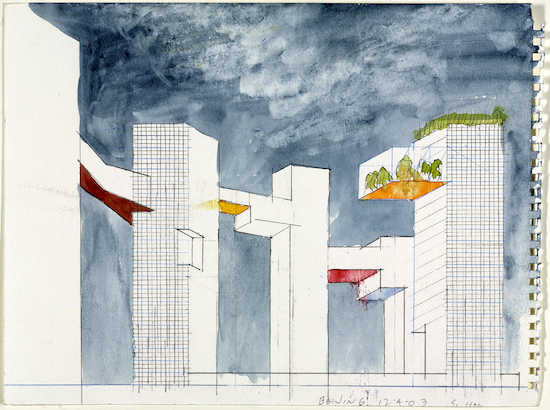 |
| Stephen Holl, Design for Linked Hybrid, Beijing, 2003, completed 2009, watercolor and pencil on paper, 22.9 x 30.5 cm The Museum of Modern Art, New York, © 2025 Stephen Holl (MOMA-P4384) |
Holl's design for the Linked Hybrid was an effort to counter the trend in Beijing towards privatized urban development. The pedestrian-oriented site is a city-within-a-city, a porous urban space around, over and through multifaceted spatial layers. It includes rooftop green areas and green terraces that encourage urban interaction among people.
Linked Hybrid contains apartments, stores, schools, theaters, gym, and restaurants. The eight-tower project is open on every side at ground level, with connections to multiple levels. It contains multi-functional sky bridges that link the towers, and has a public sky-loop of buildings that provide a panorama of the city. Geo-thermal wells 655 to 100 meters deep provide Linked Hybrid with cooling and heating, making it one of the largest green residential projects in the world.
To see the finished project: https://www.stevenholl.com/press-release/linked-hybrid-by-steven-holl-architects-named-2009-best-tall-building-overall-by-the-council-on-tall-buildings-and-urban-habitat/
Background
The first redefinition of modern architecture came in the form of a sort of rebellion against the dominance of the sterile, impersonal International Style. The International Style, characterized by sharp-edged geometry, glass curtain-wall high rises, and absence of any ornament dominated the skyline of most major cities in the world by the beginning of the 1970s.
The rebuilding of Germany after the destruction of World War II (1939-1945) started almost immediately in the International Style that had its grounding in the aesthetic theories of the Bauhaus. Many German cities became forests of glass box architecture well into the 1970s.
In the mid- to late 1970s, architects began experimenting with asymmetry, color, and exploration of incorporating historicist elements into their buildings. This rebellion against the sterility of International Style "modernism" was called Postmodernism.
By the 1990s, another group of artists began to challenge the very standard functions, uses and perceptions of architecture. Although a branch of Postmodernism, it is often called Deconstructivism, because it shatters the very foundations of the reliance on standard geometric forms as the foundation of design, and seeks to visually create architecture as sculpture in many cases.
In the early 2000s, Deconstructivist aesthetic and a return to some modernist language have evolved a hybrid architecture that defies classification. Green architecture and the humanization of urban space have been major concerns in contemporary architecture.
Stephen Holl grew up in Bremerton and Manchester, Washington. He graduated from the University of Washington, and studied architecture in Rome in 1970. He attended graduate school at the Architectural Association School of Architecture in 1976. He moved to New York and has taught at Columbia University since 1981.
In the 1990s, his design strategy shifted from one of designing buildings based on function, to an approach that concerned designing based on humans' interaction with their surroundings. This came about because of the interest he developed in phenomenology. In other words, his designs were predicated on his direct investigation and description of the site as he experienced it, not based on presuppositions or preconceptions, but on function.

Comments