Artist Birthday: Robert Longo
Robert Longo is a painter, filmmaker, photographer and musician. He first came to prominence in the 1980s, part of the Neo-Expressionism aesthetic with his Men in Cities series of works which cast a critical eye on the corporate greed and high-pressure business world of the 1980s.
Artist Birthday for 7 January: Robert Longo (born 1953 US)
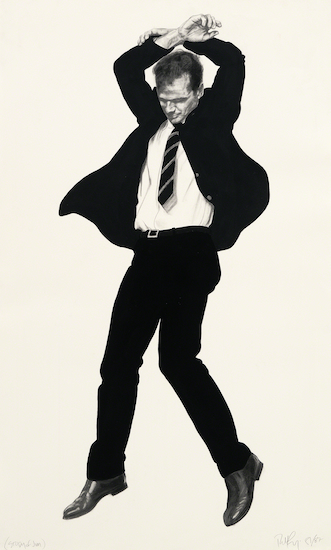 |
| Robert Longo, Rick, from the Men in Cities series, 1981-1987, synthetic polymer paint, charcoal, pastel, gouache and pencil on paper, 127 x 76.2 cm The Museum of Modern Art, New York, © 2026 Robert Longo / Artists Rights Society (ARS), New York (MOMA-P1158looars) |
Men in Cities was less about individuals than about the money-driven, stressed out professional office world. It is a comment on the booming business world of the 1980s. For these figures, Longo photographed a number of single figures clad in business attire. He then projected them on paper, or on a lithograph stone in this case, and drew the figure, allowing an assistant to fill in details. Instead of relying on a single male subject, Longo combines elements from several different poses. What emerges is an ambiguous form that could depict either agony or ecstasy, but that always has a haunting impact. Despite the seemingly tortured poses, the figures do not allude to a setting and are frozen, creating a further tension.
Background
Starting in the 1950s, several movements had challenged the primacy of painting, Minimalism and Conceptualism, for example. Yet, many artists in the last decades of the 1900s persisted in their insistence on painting as one of the most valid modes of personal expression. With the development of a variety of different approaches to art in the 1960s and 1970s, including Conceptualism, Performance Art, Environmental (Land) Art, and Process art, and the social and political critiques of women and non-white artists, it became increasingly apparent that traditional interpretations of “modernism” had, by the 1980s, become inadequate. “Modernism” was associated with Abstract Expressionism and its derivatives and seemed totally out of step with art of the end of the millennium.
A number of artists, critics and art historians declared a break with that tradition, identifying their art as Postmodernism. These artists felt that modernism was too narrowly defined and promoted male artists and did not allow for social concerns. One of the movements that resurrected the importance of painting was generally called Neo-Expressionism. Many Neo-Expressionists were drawn to painting because, historically, the medium was often closely intertwined with events in western society. This was particularly relevant to artists during the 1980s with the domination of corporate America, the disintegration of the Soviet Union and subsequent nuclear arms race, and the sudden and radical realignment of international relations called "globalization."
Although Neo-Expressionism figured, in many critics' minds, to be a return to the painterly, many of the artists relied on advertising images and photography for their works. This aspect of the movement reveals that the two major trends of the late 1900s -- Appropriation and Neo-Expressionism -- were not mutually exclusive. Additionally, many American Neo-Expressionists avoided the slashing brushstrokes and jarring color of traditional Expressionism and European Neo-Expressionism in favor of expressive subject matter, executed with the aid of photography.
Robert Longo was born in Brooklyn. He was raised on Long Island, and from an early age he participated in a variety of arts activities. He developed a fascination with all forms of mass media --television, movies, magazines, and comic books. Longo received his education from State University College in Buffalo, NY. Although Longo studied sculpture, drawing was his favorite means of self-expression. The primary focus of Longo's art of the 1980s was the corporate world, interest in which characterized that decade (think of the TV series Dallas). This was true of the corporate nature of the art market itself, with its skyrocketing prices, pressure on marketing an artist's work, and making them into "art stars."

Comments