Artist Birthday: Pierre-Auguste Renoir (1841-1919 France)
Impressionism, a painting movement that arose from the earlier Realism movement, was one of the first revolutions in the history of development of painting, wherein artists did not rely solely on commissions, nor did they observe traditional techniques of painting. Pierre-Auguste Renoir was one of the pioneers of the movement.
Artist Birthday for 25 February: Pierre-Auguste Renoir (1848-1919 France)
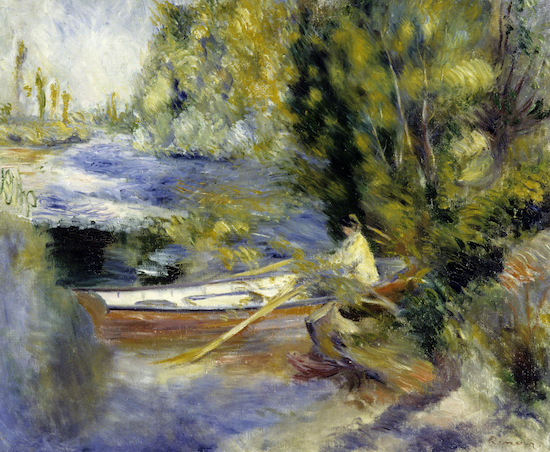 |
| Pierre-Auguste Renoir, At the Water’s Edge, ca. 1885, oil on canvas, 55 x 65 cm Image © 2026 Philadelphia Museum of Art (PMA-2616) |
Despite his on-going predominant interest in the figure, Renoir continued to produce landscapes throughout his career. Unlike his figurative compositions that were done partially outdoors and partially in the studio, he still painted landscapes completely outdoors. This scene -- presumably a quick outdoor study -- is on the coast of the Mediterranean, not far from Nice in southern France. It was a location favored by many of the Impressionists, especially Monet, because of the warm weather, brilliant light, and jewel-like colors of the water and surrounding coastline.
This landscape was painted at a time when Renoir’s figures were achieving more monumentality and solidity. The colors are more saturated and less shimmering than in his earlier backgrounds (such as in the Lunch at the Restaurant Fournaise), giving the forms of the composition more weight. However, he continues to use the high-key Impressionist palette with his trademark feathery brushwork to achieve a somewhat softened form.
Background
Painting in France in the 1830s and 1840s gradually shifted from an emphasis on the exotic and dramatic of Romanticism to an emphasis on acute naturalism based on close observation of nature. This style evolved partly from a sub-group of the Romantic movement known as Pre-Raphaelites. These were artists who preferred themes from Medieval romances, and stylistically were inclined to artists of the Renaissance before Rapheal (1483-1520). The philosopher John Ruskin, in his book Modern Painting (1843), in reference to the Pre-Raphaelites, said that painting had no higher calling than to be absolutely faithful to nature.
Whereas Romanticism relied on naturalistic detail in order to tell a dramatic story, Realism used naturalistic detail to depict everyday life without dramatic or romantic overtones. The popularity of Realism paralleled the rise in prosperity all over Europe of the middle-class and the evolution of the art form photography. As a new class of art patrons, the middle class rejected history painting in favor of scenes recognizable from their own lives. The emphasis on observed reality eventually spawned Impressionism. The Realists in France were among the first to emphasize not only optically observed realism in nature as the foundation of landscape, but also introduced the idea of painting entirely outdoors. This method was passed on to the young future Impressionists during the 1860s. These artists pioneered the first true revolution in the history of painting. They rejected the academy system with its regulations on subject matter and style, and were the first artists to emphasize personal expression instead of commission as the basis for their work.
Pierre-Auguste Renoir was born in Limoges, but the family moved to Paris when he was a child. At thirteen, he left school and was apprenticed to a porcelain painter. By the time he was seventeen, the business went bankrupt and he decided to become a full-time artist. He began his training in a way common to young artists at the time: by copying renowned works of art in the Louvre. In doing so, he developed what would be a life-long admiration of eighteenth-century French painting.
In 1860, Renoir began studying with the Swiss academic painter Charles Gleyre (1806-1874). In the course of his studies he met Claude Monet (1840-1926), Alfred Sisley (1839-1899), and Fréderic Bazille (1840-1871), all future impressionists. These artists had been influenced by the Barbizon School painters, the first group of landscape painters to advocate painting outdoors rather than in the studio in order to accurately capture nuances in light and the effects of light on local color (the color of an object). Most of Renoir’s paintings from the 1860s, however, were in an academic style.
By 1869, Renoir was painting outside with Monet. A favorite spot was La Grenouillère on the Seine. The “birth of Impressionism” is said to have happened that summer. Impressionists painted in a radically different way from academic painters. Instead of starting with a traditional underpainting of dark colors to established shadows, Impressionists applied pure, bright colors directly onto the primed canvas. This approach resulted in bright, seemingly light-filled compositions aided by the white ground of the canvas.
Because the Impressionists stressed the accuracy of perceived light and the scientific spectrum of color, they did not use earth tones in their paintings, i.e., brown, beige, or yellow ochre. Black was not used to create shadows, rather a combination of various colors according to the local color of the object. They emphasized reality of light, atmosphere and their effects on color.
Therefore, Impressionism was not accepted in the official annual shows sponsored by the conservative French Academy in Paris, nor were early Impressionist painters commercially successful. Eventually, the art dealer Paul Duran Puel became intrigued with the new style and was the first Parisian dealer to start exhibiting impressionist works. He began showing Renoir’s works regularly in 1881.

Comments