Artist Birthday: Nancy Rubins
Through sculptures assembled from discarded materials and graphite drawings that assume the appearance of liquid metal or crumpled steel, Nancy Rubins transforms quotidian objects into artworks that exceed the sums of their parts.
Artist Birthday for 3 December: Nancy Rubins (born 1952 US)
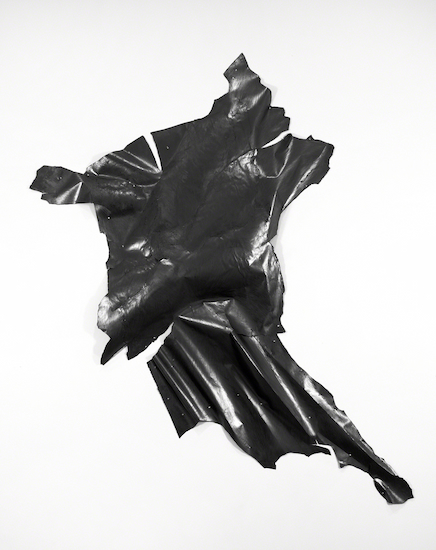 |
| Nancy Rubins, Drawing, 2007, graphite on crinkled paper, 353.1 x 307.3 cm Courtesy of Buffalo AKG Art Museum, Buffalo, NY, © 2025 Nancy Rubins (AK-2991) |
Some of Rubins' earliest work were explorations in transcending the boundaries between mediums. Her Drawing series began early in her career (1974) when she combined a penciled sheet of paper slung over a heavy rope like laundry on a clothesline. Early hybrids of drawing/sculpture introduced Rubins to the idea of using the paper not only as the support from graphic work, but also as a sculptural medium.
Rubins' drawings are usually attached to the wall, but are allowed to fall onto the floor, cross corners, or progress onto ceilings. These monumentally-scaled remnants of used paper are covered completely in glistening, gestural strokes of dark graphite. The resulting, uneven-edged pieces are gathered into folds, often assuming forms that resemble figures or landscape elements.
Background
The use of found objects is nothing new in the history of art. Dada and Surrealist artists in the early 1900s began to explore the use of found objects, much of the time garbage, in their works of art in an attempt to redefine what "fine art" is. Starting in the 1950s, assemblage artists used found industrial objects, wood scraps and other garbage to create abstract sculpture. The interest in the junk discarded by American society piqued the interest of Pop artists during the 1960s.
With the anti-pollution "Earth Day": movement that began around 1970, many artists began to explore works of art that expressed the denigration of Earth's biosphere -- natural resources and animals. The interest in recycling materials thrown away by society was reinvigorated in the 1990s by the concern about the deterioration of Earth's biosphere and the vast amounts of waste material being forced on nature. Some artists explore the use of repurposed materials to create art that relates specifically to the flora or fauna that are threatened. Other artists use refuse to create abstract statements.
For years Nancy Rubins has used industrial, household and personal garbage to create monumental abstract sculpture. Born in 1952 in Naples, Texas, she received her BFA from the Maryland Institute College of Art, Baltimore (1974), and her MFA from the University of California, Davis (1976). At an early point in her career (1975), she experimented with a blending of found thrown-away objects that were not traditionally associated in the same work.
Rubins' works are guided by aesthetic and formal concerns, rather than strictly environmental ones. She does admit that she is willing to create something out of anything used presented to her. Her strict adherence to used objects, however, challenges even the most contemporary perceptions of sculpture. Her work relies on exciting interplay of gravity, balance and form.
Correlations to Davis programs: Explorations in Art 2E, Grade 5, Unit 3.8 ; Davis Collections -- Texas Art and Artists

Comments