Artist Birthday: Mori Mariko (born 1967 Japan)
Mariko Mori is an internationally acclaimed artist whose practice explores universal questions at the intersection of life, death, reality, and technology. She is known for her photographs and videos of her hybridized future self, often presented in various guises and featuring traditional Japanese motifs.
Artist Birthday for 12 February: Mori Mariko (born 1967 Japan)
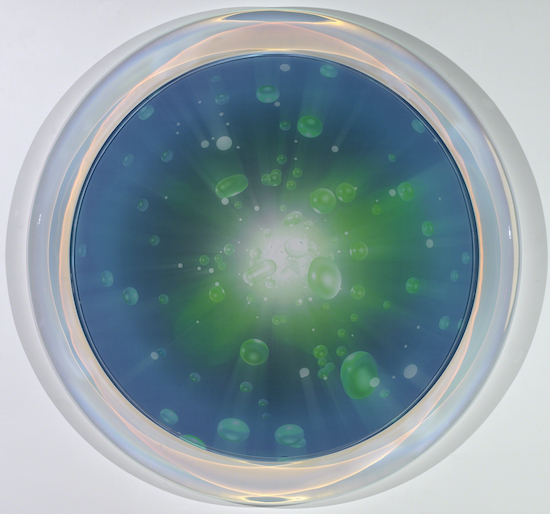 |
| Mori Mariko, Connected World (Photopainting III), 2002, dye destruction print and Lucite, 121.9 x 121.9 cm Buffalo AKG Art Museum, Buffalo, NY, © 2026 Mariko Mori / Artists Rights Society (ARS), New York (AK-4355mmrars) |
These luminous photographs currently extend Mori’s inquiry into the mysteries of the universe through her deepening interest in unobservable energy. These reflect her ongoing interest in the constantly expanding universe and visualization of the Big Bang Theory. Like her early works, her painting/photographs explore futuristic worlds. Like her Wave UFO of 2003, these outer space-like photographs are expressions not only of what humans have not seen in person, but they are symbols of the human mind and its ever expanding curiosity into the unknown, always a component of Mori's art.
Background
In the late 1900s, Communism collapsed in eastern Europe and Russia, and many national borders changed. Because borders help formulate identity, many artists began to address the idea of borders and the assertion of cultural identity. Artists who root their art in identifiable social groups can either define the flaws within that subculture, or demonstrate how open the group is to new influences.
Visual arts have historically been modes of expression specific to particular cultures. That means that art can assert cultural identity. However, it also means that art can reinforce simplistic, or even negative visual prejudiced characterizations. Many contemporary artists exploring their own cultures in one way or another are careful to avoid hackneyed ideas about their culture. Their art rises above nationalistic, or cultural categories, bringing authenticity to their work.
The art of Mariko Mori has explored issues of desire and fantasy in performance, photography and video. She is one of a number of artists who explores the intersection of the anime culture (a subculture influenced by Japanese modern cartoons, science fiction and technology) and contemporary culture. She was recognized for her early work that explored Japanese notions of reality contrasted with the technological fantasy world that Japanese media has generated. Her work now concentrates on the intersection of humanity, reality, death, and technology.
Mariko Mori was born in Tokyo, the daughter of an art historian and inventor. She studied fashion design and briefly worked as a fashion model. Mori then studied art at Chelsea College of Art and Design in London (1989-1992). Between 1992 and 1999, Mori explored many different personas in varying costumes. These came in the form of photographs staged with great attention paid to detail, be it Mori dressed as a cyborg young woman (such as Play with Me 1994), office secretary (such as Tea Ceremony 1995, or extraterrestrial goddess (such as Esoteric Cosmos 1998-1999).
Between 1999 and 2005, Mori creative immersive, interactive installations which explored extraterrestrial space, peoples’ brain waves, and the intersection of human beings with alien technology. These installations were often combined with Mori’s own animation. Such installations often combined ideas of spirituality with technology. Whereas her earlier works dealt with coming-of-age issues of conformity, independence and media refuges of the young (science fiction, manga, graphic novels and comics), at the end of the 90s Mori’s focus shifted to concerns for humanity and the planet and an expansive notion of time, with past, present and future occurring simultaneously.
Correlation to Davis program: Davis Collections -- Japanese Art

Comments